Leverage crises in APSA interventions: design or coordination flaws?
Without members’ backing for African-led initiatives, even the most sophisticated security architecture will continue to yield diminishing returns in conflicts.
Nearly a decade later, the African Peace and Security Architecture (APSA) is struggling to shape outcomes in Sudan, the Democratic Republic of the Congo (DRC), South Sudan, Mozambique, and the Sahel, as external actors reassert dominance over Africa’s security landscape.
The year 2026 marks the tenth anniversary of the African Union (AU) reform proposed in 2016 and launched in 2017 to enhance the effectiveness of African-led interventions. In the peace and security domain, the reform sought to strengthen APSA, including the AU Peace and Security Council (PSC) and coordination with regional economic communities (RECs).
Mounting challenges in AU interventions prompted a call at the February 2025 summit to review its peace and security frameworks. However, a high-level panel in September 2025 concluded that the AU already has one of the most comprehensive normative architectures, despite some lack of clarity in parts of its framework.
Several institutional measures were introduced to address these gaps. The political affairs and peace and security departments were merged in 2021 to improve coordination between political and security initiatives. A mid-year collaboration of the AU, RECs and regional mechanisms (RMs) began in 2019 to improve relations between the AU and subregional bodies on responses to several issues, including peace and security. The AU Peace Fund was revitalised in 2018.
Despite APSA’s robust frameworks and institutional realignment, APSA decision-makers who routinely invoke ‘African solutions’ undermine regional initiatives and seek external conflict mediation, treating African-led interventions as optional or secondary. This hollows out the influence of African actors.
APSA decision-makers invoke ‘African solutions’ but seek external conflict mediation
This decline in Africa’s influence and centrality in its security landscape raises questions about whether AU leaders are missing a point. Has the reform agenda – with its focus on structures, modalities and financing – sidelined the more urgent task of sustaining collective African conflict responses grounded in member states’ unity of purpose?
Decline and fragmentation in collective response
When the reform was proposed in 2016, the AU was already facing a weakening role in major crises in Africa, compared to its first decade. Then it drove mediation and peace support operations (PSOs) across regions backed by member states’ common interest in pan-African solutions.
|
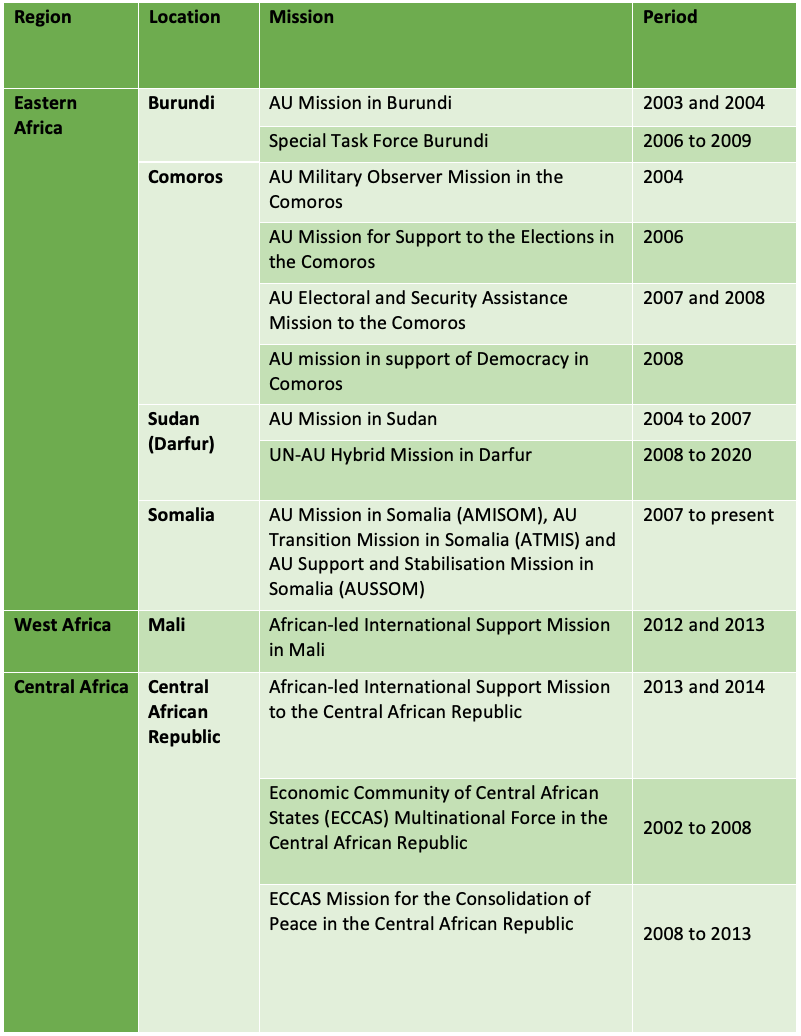
AU and RECs PSOs from 2003 to 2014
|
While establishing PSOs is not the major pathway to peace, the table shows how willing the AU was to support political processes between 2003 and 2014, with the backing of its members and external financial support. Its activities began even before it had key intervention frameworks. This changed from 2013 due to less funding and increasing subregional interest in assuming PSOs without deferring to the AU.
Notably, the United Nations (UN) took over the Mali and Central Africa Republic missions in 2013 and 2014. In 2016, the PSC reversed a decision to deploy a mission in Burundi, inadvertently creating a risk aversion in the Council for approving future missions. The joint AU-UN mission in Darfur was closed in 2020. This left the AU with Somalia as its only active PSO, albeit donor-dependent.
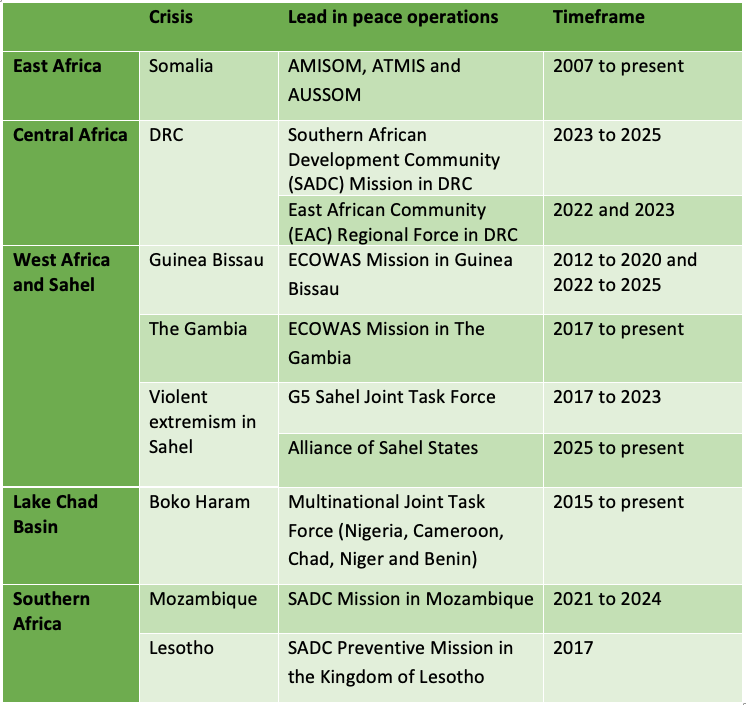
While the number of AU-led interventions declined, there was a rebound in major REC-led peace initiatives from 2013 to 2023, particularly PSOs, signalling REC preference to address their challenges rather than wait for AU-level consensus. This is seen in Lake Chad Basin, The Gambia, Lesotho, Guinea-Bissau, Mozambique and DRC.
|
AU, RECs/RMs military interventions from 2015 to 2025
|
As subregional interventions became common, cleavages deepened in the extent to which regions could independently lead peace initiatives, considering the AU’s primacy in African peace and security. Tensions such as those between the AU and ECOWAS in Mali prompted ongoing efforts to clarify the division of labour between the AU and RECs as part of AU reform.
Among RECs, limited cross-regional dynamics became a worrying dynamic, leading to ad hoc subregional mechanisms. The lack of cohesion means that the AU and subregions are currently underperforming in today’s conflicts, thereby fostering external intervention.
Coordinating mediators instead of warring parties
The eastern DRC illustrates the pitfalls of weak cohesion. When the M23 rebellion resurfaced in 2021, different AU institutions intervened with limited coordination, as the DRC, like many African countries, is a member of multiple RECs. The EAC deployed a force from 2022 to 2023, followed by a SADC mission from 2023 to 2025. Both withdrew without collaborating or achieving security gains.
The eastern DRC situation illustrates the pitfalls of APSA’s weak cohesion
In June 2023, the AU brought together the EAC, SADC, International Conference on the Great Lakes Region (ICGLR) and UN under an AU-led roadmap. Yet during this period, Qatar (July 2025) and the United States (November 2025) brokered temporary arrangements with conflict parties. While fragile, these deals underscored that influence over belligerents matters more than jurisdictional claims. Recent dynamics mark a departure from earlier episodes when the ICGLR helped end the M23 rebellion in 2013.
A high-level January 2026 meeting in Togo ended with an agreement on a unified mediation framework to resolve the eastern DRC conflict under AU leadership. This is positive, but it continues the AU trend of coordinating the growing number of regional and international mediators, while its own capacity to influence warring parties remains low.
Similarly, in Sudan, the AU leads an expanded mechanism that coordinates the Intergovernmental Authority on Development, the UN, the Arab League, the European Union, and others.
Although the AU continues pushing for peace through its high-level panel for Sudan, external players have brokered consequential but temporary deals. While the AU-led mechanism pushed for a political framework in Sudan, a 2023 US-Saudi-mediated process led to temporary ceasefires.
States should be persuaded to invest their diplomatic, economic and military capital in AU-led initiatives
AU coordination is important, ensuring that mediation aligns with African frameworks and goals. But mediator coordination often portrays the AU as seeking relevance through geography and turf politics rather than exerting actual influence on the conflict parties. This perception is reinforced by limited political backing for AU and REC mediators, particularly from regional powers, which undermines their credibility and bargaining power.
In search of leverage
Recent Sahel dynamics further expose the gap between rhetoric and collective action. As Russia consolidates influence regionwide, neither the AU nor ECOWAS has fulfilled longstanding commitments to deploy a specialised African Standby Force unit against violent extremism. Despite its plans, the 2015 AU-led Nouakchott Process has yet to deploy a counter-terrorism force for the Sahel-Saharan region. Because RECs seem to have absolute control over their regional standby forces, the AU cannot deploy these forces to joint missions.
Warring parties and coup states, such as Alliance of Sahel States members are aware of APSA’s waning influence due to years of unimplemented decisions and an unwillingness to impose sanctions on spoilers of peace in conflict countries. While institutional reforms are crucial, the AU should persuade member states to invest their diplomatic, economic and military capital in AU-led initiatives. But how to make that happen is a challenge.
Dr Paul-Simon Handy is the Institute of Security Studies representative to the AU. He notes that ‘AU effectiveness lies both in getting the institutional reform right ― ensuring that states see the AU value for money ― and in fostering the political will for states to back collective response via the AU.
Any solution will require individual states to reap the practical value of collective action, not as abstract pan-African idealism, but as a strategic investment in national, regional and continental stability.