Can APRM-PSC cooperation finally drive preventive action in Africa?
Africa's governance and security institutions are coordinating better – but the gap between diagnosing risks and acting on them remains structural.
The Africa Peer Review Mechanism (APRM) and Peace and Security Council (PSC) interface represent a structural paradox at the heart of the African Union (AU): one generates detailed governance intelligence; the other wields the authority to act on it. Yet no binding mechanism connects the two.
The fifth joint APRM-PSC retreat was held in April 2026 in Burayu outside Addis Ababa under the theme ‘Governance, early warning and preventive diplomacy’. It advanced efforts to integrate governance assessment into continental peace and security decision-making across the AU ecosystem. A key outcome was the Burayu Declaration, a framework for enhanced cooperation between the two bodies, including commitments to stronger early warning integration, institutional interaction and follow-up.
Despite this progress, the cooperation continues to face structural constraints that hinder the two parties’ ability to translate governance analysis into preventive action. This article assesses this situation through four challenges: absence of decision-making channel, institutional duplication, institutional relevance and operational constraints.
Absence of decision-making channel
A central weakness in APRM-PSC cooperation is the lack of a formal mechanism linking governance findings to PSC decision-making. The APRM diagnoses governance risks; the PSC has the authority to prevent peace and security threats. But no institutionalised, consistently applied channel requires the PSC to regularly consider APRM findings.
Even after the institutionalisation of joint retreats since 2021, which started 18 years after the APRM was established, that organisation’s outputs remain advisory rather than actionable. The Burayu Declaration improves coordination language but does not establish mandatory referral thresholds for high-risk governance findings, time-bound PSC responses to APRM alerts nor enforcement mechanisms for follow-up.
The declaration signals intent to address these gaps, including efforts to formalise APRM into a continental early warning process. However, implementation modalities remain unclear, preventing systematic conversion of governance intelligence into preventive action.
The Burayu Declaration seeks to strengthen early warning, interaction and follow-up
This gap is exacerbated by weak compliance with the African Charter on Democracy, Elections and Governance, ratified by 39 states but with limited reporting, with only two implementation reports (state-party reports) submitted under Article 49 of the charter. This reinforces weak accountability.
Institutional duplication and fragmentation
APRM-PSC coordination is further constrained by overlapping AU governance and security frameworks. Alongside the APRM, member states are subject to charter governance obligations, Continental Early Warning System assessments and tools such as the Continental Structural Conflict Prevention Framework and Country Structural Vulnerability Mitigation Strategy.
While these instruments share the objective of preventing instability, they operate in parallel, using similar indicators and producing overlapping reports. This has created duplication of assessments, fragmented reporting obligations and a diffusion of responsibilities. Rather than being a unified system, the AU governance architecture functions across many diagnostic streams with no single action pathway.
The Burayu Declaration acknowledges the need for harmonisation, but has not yet established a consolidated governance reporting framework. This is despite calling for enhanced coordination and information sharing across the African governance and peace and security architectures.
Is the APRM still necessary?
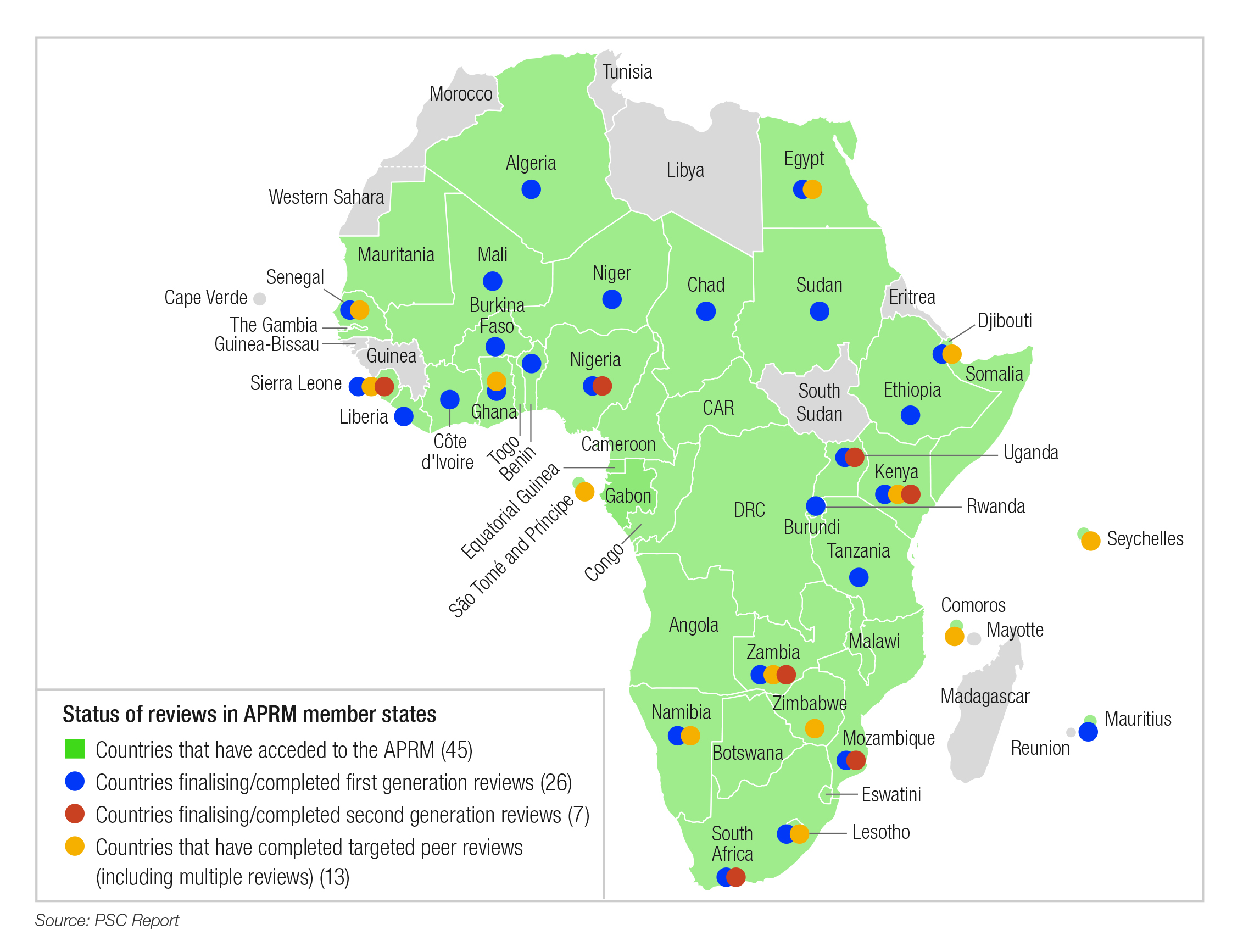
A recurring but underexamined question is whether the APRM remains necessary given the proliferation of AU governance and security instruments. On one hand, it is the most comprehensive governance diagnostic mechanism in Africa, covering political, economic and institutional governance across 45 states acceding to it, the latest being Somalia, which joined in February 2026. It has also expanded into emerging technologies, particularly through the inclusion of digital governance as a sixth theme in its 2025 to 2028 strategic plan, alongside strengthened attention to cross-cutting governance challenges such as climate-related risk and financial integrity.
As stated by APRM Chief Executive Officer Marie-Antoinette Rose-Quatre at the fourth APRM-PSC retreat in 2025, the APRM’s preventive value is reinforced by evidence from past reviews, which have repeatedly identified governance risks well before escalation. These included early warnings on xenophobic violence in South Africa (2007 review) and centre-periphery governance tensions that led to the conflict in Tigray in 2020 (2011 review). It also flagged electoral violence risks in Mozambique (2019 review) and structural civil-military imbalances in Sudan (2020 governance gap analysis). These cases underscore that governance-security risks are often diagnosed early but not acted on in time.
Rather than being a unified system, the AU governance architecture has no single action pathway
This concern is echoed in the declaration, which emphasises the need to strengthen the link between governance assessments and early response mechanisms. On the other hand, its voluntary nature and weak enforcement capacity limit its ability to influence state behaviour, creating a persistent gap between early warning and prompt intervention. Yet, despite clear linkages to peace and security risks, APRM findings are not systematically integrated into AU organ decision-making.
The core issue is not redundancy but lack of institutional integration. The APRM provides deep analysis, while the PSC wields decision-making authority. The absence of structured linkage between the two creates inefficiency. The evolution of joint retreats since 2021, culminating in the declaration, reflects a gradual recognition feeding into enforcement-capable institutions rather than operation in isolation.
|
Status of reviews in APRM member states
Source: PSC Report
|
Capacity and implementation gaps
Even where coordination improves, the APRM faces chronic funding instability, reliance on voluntary contributions and uneven technical capacity across member states. This reality is acknowledged by AU Assembly decisions at the 39th AU summit in February 2026, which repeatedly stressed the need for increased APRM financial and human resources.
Strengthen national capacity and resources to implement action plans following APRM reviews
Nationally, implementation of recommendations remains weak due to limited institutional capacity for absorption and competing political priorities. Without a strong foundation, improved coordination – despite strong diagnostics – could weaken execution. The declaration also highlights the need to strengthen national capacity and resources to implement action plans following APRM reviews.
Evolution of cooperation
Before 2021, cooperation between the APRM and PSC was largely informal, characterised by ad hoc exchanges with limited institutional follow-up. Since the first joint retreat in 2021, cooperation has gradually evolved.
The declaration and planned roadmap are the most formal articulation to date of APRM-PSC coordination and include commitments to institutional interaction, early warning integration and implementation tracking.
Notably, the final declaration narrowed draft references on worsening conflict trends and prolonged political transitions while dropping broader language linking youth empowerment to AfCFTA, agricultural transformation and employment. It expanded provisions on intelligence coordination with African Union Mechanism for Police Cooperation (AFRIPOL), Committee of Intelligence and Security Services of Africa (CISSA) and the African Union Counter-Terrorism Centre (AUCTC), suggesting a shift toward a more institutionalised and security-oriented framing of the governance of prevention.
However, this evolution remains incremental rather than transformative, as implementation mechanisms remain only partially defined and largely dependent on follow-through whose crystallised outcome would be expected in the roadmap.
From coordination to better cooperation
The APRM-PSC interface reflects a broader structural AU challenge: the gap between governance, and intelligence and security action. The declaration and roadmap signal growing political recognition of this gap and provide a structure for cooperation. However, it remains to be seen whether it will resolve the core constraint: the absence of binding mechanisms that translate governance assessment into timely PSC action.
The key challenges are no longer analytical capacity, but institutional design –specifically, how to ensure that governance risks identified by the APRM systematically trigger preventive diplomacy or intervention by the PSC. Until formal escalation protocols, unified reporting systems and enforcement mechanisms are established, APRM-PSC cooperation will remain consultative rather than operational. The test for the AU is whether it can move from generating governance knowledge to acting on it before it escalates into instability.