How did Angola perform as the AU chair?
Despite noticeable gains, chronic challenges hindered Angola’s tenure at the helm of the African Union.
Angola assumed the AU Assembly bureau chairship on 15 February 2025 during the 38th ordinary summit in Addis Ababa, Ethiopia. It's taking over from Mauritania, continuing the rotating regional chairship as provided for in Article 6(4) of the AU Constitutive Act. It was a leadership transition from north to south.
Unlike its predecessor, which was unprepared due to regional struggles over the AU Assembly leadership seat between Morocco and Algeria, Angola had a full year to hone plans for its tenure. It was part of the outgoing bureau in line with the AU institutional troika, which features the incumbent, the past chair and the incoming chair. As the troika was not limping, as in 2023 during Comoros’ tenure, AU learning was fostered within the Bureau, enabling Angola to prepare better.
Such readiness was evident in the country’s assumption speech, which outlined clear priorities in crucial continental policy, including peace, governance and security, infrastructure, education and human capital development. Given the pivotal role Angola has played in African peace and stabilisation, it had sufficient credentials to thrive. This was notable in the Democratic Republic of the Congo (DRC) crisis, its regional positioning in the Southern African Development Community, its PSC membership and its economic development.
Much was expected from the past chair’s tenure. Angola’s handing over of the AU Assembly leadership to Burundi during the AU 39th ordinary summit in February 2026 was an opportune time to look back on its term. The review focused on achievements and challenges that could offer lessons for the current and future chairs.
Recalling Angola’s priorities
From Angolan President João Manuel Gonçalves Lourenço’s chairship speech during the AU 38th summit, six priorities were identified (see table below). According to the PSC Report, he prioritised peace and security as foundational to development in Africa, in line with the Agenda 2063 'silencing the guns' agenda. Another focus was infrastructure development, which, according to some AU staff, was considered a precondition for the success of the African Continental Free-Trade Area (AfCFTA).
Angola stated its priorities in February 2025 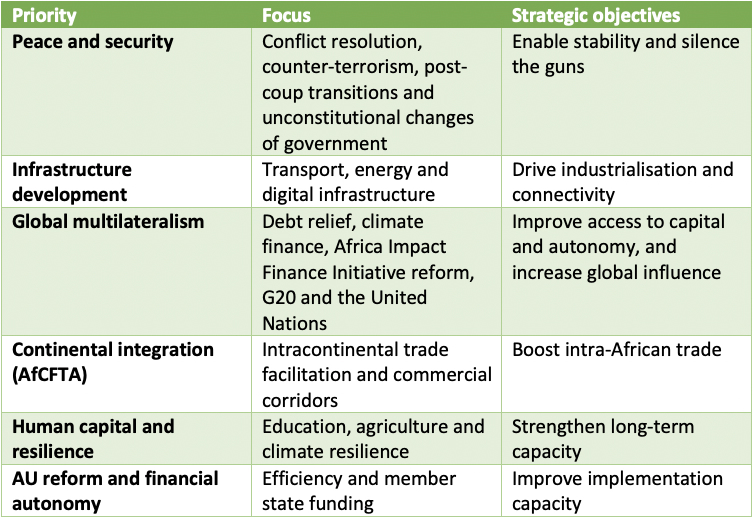 Source: President Lourenço’s speech during the AU 38th ordinary summit Source: President Lourenço’s speech during the AU 38th ordinary summit
|
However, Angola did not depart from its predecessors, Comoros and Senegal, retaining a comparable range and number of priorities. These continued efforts to address continental challenges contrast with the AU Assembly’s calls for narrower priorities. Delivering on several priorities has been a test for AU chairs.
Marking achievements
Angola’s impact was perceptible mostly in advocating infrastructure development. One achievement was the Luanda Infrastructure Financing Summit. Held from 28 to 31 October 2025, it sought to generate strategic orientations on how infrastructure can unlock Africa’s industrial potential under AfCFTA. The theme was ‘Capital, corridors, trade: investing in infrastructure for AfCFTA and shared prosperity’.
Angola’s priorities included peace, governance and security, infrastructure and education
It brought together continental decision-makers and partners, including the private sector, international development agencies and financial institutions, such as the African Development Bank and Afreximbank. It gave African-led infrastructure initiatives momentum and secured the commitment of financial institutions to support ongoing and upcoming Agenda 2063 projects.
Unlike previous forums, said a policymaker, private sector participation at the Luanda summit was unprecedented, with the private sector owning the debates on the African infrastructure development vision.
Angola also stepped up its conference diplomacy to advance African agency in global fora. United Nations Security Council reform and Africa’s meaningful participation in the G20 through the AU were prominent on the agenda. Although Angola wasn’t the first country to prioritise these issues, it helped keep up its political momentum.
Moreover, Angola hosted the seventh AU-European Union summit on 24 November 2025, which delivered strong support for multilateralism, a strengthened partnership and shared commitment to a rule-based international order with the United Nations at its core. Issuing a joint press release as they did was commendable, given that the two partners didn’t agree on outcomes during previous meetings. This demonstrated Angola’s ability not only to drive consensus among AU states but to assuage partners, especially when fragmentation has become the norm in global multilateralism.
Other impacts included the executive council’s deliberation on the AU Commission’s skill assessment and competency audit during the July 2025 AU and regional economic communities/regional mechanisms mid-year coordination meeting. The adoption of the AU Assembly's new working methods was also commendable.
Angola’s impact was perceptible mostly in advocating for infrastructure development
This facilitated the ongoing implementation of outcomes from an eight-year-long process, resulting in the placement of 617 staff deemed fit for continuation at the AU Commission and the separation of 187 unfit staff.
Many observers and AU staff believe the decision could boost the commission’s delivery capacity. Many praised Angola’s leadership in advancing the competency audit process, an essential pillar of ongoing AU reform, in close collaboration with AU reform champion, Kenya’s President William Ruto.
The new working methods, adopted at the 39th summit, also streamlined meeting agendas and reduced meeting length. According to most policymakers consulted, this is an Angolan strategic legacy for the AU, as full implementation could ensure greater focus on key issues, optimal use of resources and reduced duplication of decisions.
Shortcomings
Despite the outgoing chair’s achievements, stakeholders, including policymakers from member states and AU Commission experts, have raised three main challenges. The first is the prioritisation of six vast domains. Addressing peace and security alone has been daunting, given the persistence of major crises in Angola, the DRC, the Central Sahel and countries experiencing unconstitutional changes of government.
Even though the chair, as a PSC member until 31 March 2026, and the AU Assembly bureau accelerated efforts to address these situations, their impact is perceived largely as scratching the surface. Angola’s efforts were watered down by antagonistic parties that were not committed to African-led processes.
Numerous priorities compete for attention, but a short tenure needs focus
An expert told the Institute for Security Studies that DRC President Felix Tshisekedi did not inform Lourenço about his visit to Luanda before the Doha talks. At some point, Rwanda was not receptive to numerous calls for direct talks with the DRC. Such slippages did not ease Angola’s mediation.
Furthermore, addressing peace and security has been difficult for almost all chairs over the last five years, as the same crises persist. Similar issues were evident with human capital and resilience, as well as AU financial autonomy, which have not gone beyond conference diplomacy and rhetoric.
Many experts and AU staff interviewed noted that the chair was overstretched across priorities. Thus, it tended to focus on Agenda 2063 areas that aligned more closely with its national interests, notably AfCFTA, infrastructure, with the Lobito Corridor at the centre.
Then there are the AU’s chronic financial challenges, especially given that its programme budget is funded 85% by external partners. Despite its expressed will to foster AU financial autonomy, Angola couldn’t reverse the curve, given member states’ limited commitment. Moreover, crucial areas such as peace support operations, including the AU Support and Stabilisation Mission in Somalia, remain underfunded.
The third limitation was the lack of clear success metrics and a publicly available work plan. Angola suffered from an endemic flaw that AU chairs have faced: the absence of AU Assembly chairship guidelines defining key performance indicators and prioritisation criteria.
Lessons from Angola’s tenure
Even though numerous priorities compete for continental leadership’s attention, a short tenure needs focus. The AU Assembly bureau should make this a must. Identifying priorities accurately requires a collegial rather than chair-led decision.
Furthermore, clear guidelines should be considered to generate institutional metrics for assessing tenures. A clear work plan with performance indicators could complement the guidelines to foster accountability and learning.
Ultimately, complex issues are handled quickly. Therefore, the milestone approach would be better suited than the informal ‘achievement vs failure’ criteria by which chairs are currently assessed.