Infrastructure a must to boost Africa’s artificial intelligence sovereignty
Without massive state and private sector investment in power, connectivity and computing, Africa’s AI governance ambitions will remain aspirational.
At its 1339th session in Addis Ababa, Ethiopia on 16 April 2026, the African Union (AU) Peace and Security Council (PSC) took up artificial intelligence (AI), evaluating its implications for Africa’s governance, peace and security. The meeting acknowledged Ethiopian Prime Minister Dr Abiy Ahmed’s designation as the AU Assembly AI and digital health champion and underscored the need for Africa to shape, control and assert sovereignty over AI within the broader ecosystem.
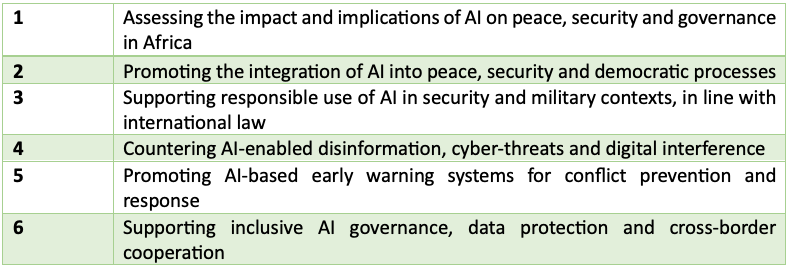
These ambitions are backed by a growing normative architecture. The Malabo Convention on Cybersecurity and Personal Data Protection, together with the continental AI strategy, provides Africa’s roadmap to AI sovereignty. To operationalise the agenda, the PSC established the AI Advisory Group on Governance, Peace and Security at its 1 214th session to implement the AU AI agenda from 2024 to 2028. The group has five members, one per AU region, with a sixfold mandate covering AI governance in peace and security, as detailed in its information toolkit.
Although the PSC and the AU Commission have made commendable norm-setting advances, the approach remains defensive for many policymakers and experts. Some argue that the AU is trying to regulate something Africa doesn’t own or have sovereignty over. This raises a more fundamental question: can Africa achieve AI sovereignty without first closing its infrastructure gap?
Africa risks regulating AI it doesn’t own, from infrastructure it cannot build
Ambition vs infrastructure gap
The AI strategy and the advisory group toolkit clarify AU objectives, as summarised in the chart below. First is setting norms for a safe environment for AI use across domains, including governance, peace and security. Second is institutional control of AI through data protection and countering AI-enabled disinformation, cyber-threats and digital interference. Third is advocating AI-powered tools to enhance conflict anticipation/prevention and, ultimately, improve African citizens’ safety and socioeconomic conditions.
|
Chart 1: Objectives of the continental advisory group's four-year mandate
Source: PSC communique 1 214 (2024) and advisory group information toolkit (2026)
|
In the absence of infrastructure that enables homegrown AI and effective data control, any bid for AI sovereignty will be difficult to sustain. AI infrastructure, according to an information technology expert consulted, comprises four layers: electricity and power supply, computing hardware (graphics processing units, datacentres and servers), cooling and physical infrastructure, and connectivity and data ecosystems. Large language models such as OpenAI’s ChatGPT, Google’s Gemini and Anthropic’s Claude require tens to hundreds of megawatts each — a threshold Africa’s power supply cannot reliably meet.
According to the International Energy Agency, Africa represents only 3% of global electricity generation and installed power capacity. The power system is unevenly distributed, with South Africa and North Africa accounting for 65%, even though they represent less than 20% of Africa’s population. This deficit is confirmed by the Institute for Security Studies’ African Futures, which states that 600 million African citizens remain without electricity.
On current trends, 543 million people will remain without electricity. Such weak, unreliable supply, coupled with shrinking financial resources, prevents the development of the computing hardware and connectivity systems that AI requires. Internet access compounds the problem: in 2023, for instance, only 34% of Africa’s population had internet access, well below the global 66% — a gap driven primarily by inadequate infrastructure investment.
Africa generates only 3% of global electricity — AI requires hundreds of megawatts
Risks
AI sovereignty is the ability of a state, institution or company to develop, host, regulate and use AI systems with meaningful autonomy, rather than over-relying on external infrastructure, cloud providers and datasets. The infrastructure deficit impedes the development of two core elements ― datacentres and data-hosting servers. Africa’s AI ecosystem is already dependent on US, Chinese and European firms and Middle Eastern datacentres. This renders Africa a consumer of imported AI rather than a sovereign and reliable producer.
Dependence on external providers also creates acute data control and ownership challenges. AI models, particularly large language models and those built on machine/deep learning, require massive datasets spanning sensitive domains — healthcare, finance, biometrics, security. The risks of informational dependency, foreign ecosystem dominance and political influence remain high. Countries and companies that own and/or host key AI infrastructure could leverage their control to achieve strategic, economic or political goals. This is particularly plausible amid current geopolitical fragmentations.
Endogenous investment across the AI ecosystem is the only path to meaningful sovereignty
Options
Closing the gap requires massive infrastructure investment. Annual needs are estimated at cost of US$130–US$170 billion, against current investment of US$80 billion. Closing the energy gap alone requires US$64 billion annually by 2030. To sustain Africa’s AI ambitions, much more will be needed, according to experts consulted by the PSC Report.
A first step could be Grand Inga Dam, an Agenda 2063 flagship. At a projected capacity of 43,200 megawatts, it would go some way toward meeting Africa’s average need of 110,000 megawatts — and success could pave the way for continent-wide duplication.
Internet connectivity should be expanded to support large language models, as well as for computer vision, robotics and other AI, essential to domains such as health, education, defence and intelligence. Endogenous investment, blending AU member states and the African private sector, would enable Africa’s AI sovereignty across the ecosystem, including power generation and internet provision. The Programme for Infrastructure Development in Africa, under the AU’s auspices, offers a ready vehicle to advance this agenda.