Repositioning the AU PSC: Capacity gaps to meaningful influence
The new council faces capacity constraints and geopolitical pressures, testing its ability to assert African-led solutions and shape conflict outcomes.
During the African Union (AU) summit in February 2026, 10 states were elected to the Peace and Security Council (PSC) for a two-year term from April 2026 to March 2028. Benin, Gabon, Lesotho, Morocco, Somalia and South Africa were elected into the 15-member PSC, while Côte d’Ivoire, the Democratic Republic of the Congo (DRC), Sierra Leone and Uganda were re-elected. The five existing members with three-year terms are Ethiopia, Nigeria, Algeria, Cameroon and Eswatini.
The mandates of both two-year and three-year term members will end on 31 March 2028, the second time when all terms will end at the same time, after the first occurrence in 2010. Except for Somalia, all those elected have been PSC members before. The rotating memberships often present the AU with renewed opportunities to tackle crises through a relatively new lens. The stakes are high for the new PSC configuration, as African citizens demand African agency amid multiple instabilities and security challenges.
Although the PSC is the AU’s key decision-making organ for conflict prevention, management and resolution, external actors are influential in the continent’s conflict landscape, raising doubts about commitments to African solutions. The United States and Middle Eastern countries are currently leading decisive peace efforts in the DRC and Sudan, while Russia is stamping its claim in West Africa’s Sahel countries and the Central African Republic.
Stakes are high for the new PSC configuration, as citizens demand African agency amid instability
The recently established Board of Peace further undermines the crisis-management relevance of multilateral mechanisms such as the UN Security Council (UNSC) and the PSC. Questions persist about the PSC’s ability to decisively influence conflict trajectories and maintain normative authority in future. With the current constraints, can the PSC deliver more creatively, leveraging both its strengths and weaknesses?
Face-off averted
Elections to the PSC have become increasingly competitive over the years, especially when rival countries vie for a seat. The dynamics leading to Morocco's election was tense, because Morocco, the Sahrawi Arab Democratic Republic (SADR) and Libya vied for one seat. Observers were concerned about the re-emergence of contestation between the Morocco and SADR camps, even though Morocco has garnered significant African support since it rejoined the AU in 2017.
But a few days before the AU summit, SADR voluntarily withdrew from the elections, opting to back Libya, which hasn’t occupied the PSC role since March 2012. Libya’s internal crises and divided government precluded it from serving effectively, resulting in a mere 12 votes compared to Morocco’s 32. Libya ceded its membership to Morocco for the April 2022 to March 2025 tenure.
SADR’s move to withdraw seems strategic, because even if elected to the PSC, it cannot raise the Western Sahara debate. In July 2018, the AU decided via Assembly/AU /Dec.693(XXXI) that it would fully support United Nations (UN) mediation and that the Western Sahara debate would be raised only by the AU troika, namely its outgoing, current and incoming chairpersons, and the chairperson of the AU Commission.
Reports on the UN process can be reported only at AU Assembly level and at the sparse PSC heads of state meetings. Since 2018, the Western Sahara debate hasn’t been discussed at the PSC, nor has there been any AU report on it.
Strength in weakness?
Somalia and the DRC are in conflict and are both serving two-year UNSC and PSC terms. Their experience in conflicts qualifies them to push for localised solutions to crises and the imperative of civilian protection in their countries and others affected by conflicts.
Somalia’s first membership of the PSC coincides with its second stint as a non-permanent member of the UNSC since 1972. Somalia could seek to align PSC and UNSC resolutions to ensure sustainable peace and decisive action against al-Shabaab.
The AU seem desperate to whitewash unconstitutional changes of government despite its principles
Somalia, DRC and Liberia, are the three African non-permanent representatives of UNSC. This A3 has since expanded into A3+, with Caribbean representation. Although A3+ members face capacity constraints, their alignment with the PSC offers an opportunity to strengthen African and Caribbean interests at the UNSC. Yet, this requires the PSC to become proactive in crisis response, leading narratives and perspectives on conflict prevention and management, thereby setting the pace for external involvement.
Normative integrity for norm-breakers?
Article 25(4) of the African Charter on Democracy, Elections and Governance prohibits juntas from running for democratic elections. Yet, Gabon’s junta stood for and won elections in April 2025 following the ousting of former president Ali Bongo. The PSC immediately lifted the suspension on the country. Similarly, Guinea’s suspension was lifted in January 2026 following the 28 December 2025 elections after the junta won. Gabon is not a party to the charter but Guinea is, which highlights the AU’s desperation to whitewash unconstitutional changes of government despite its principles.
Gabon was elected to the PSC during the AU summit in February 2026, a seeming violation of Article 5(2g) of the PSC protocol, which requires PSC members to be elected in ‘respect for constitutional governance, in accordance with the Lomé Declaration as well as the rule of law and human rights’.
Successive PSC retreats have repeatedly emphasised the need to apply the criteria strictly. But many African states lack a track record of good governance and rule of law.
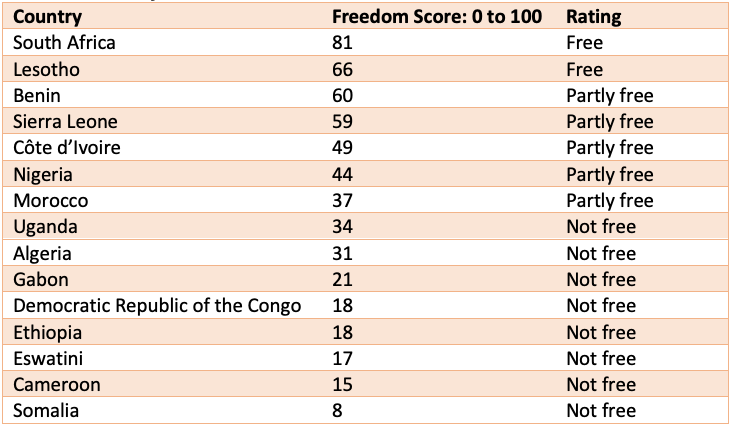
The worst and unacknowledged unconstitutional government changes are orchestrated by authoritarian democracies via lawfare and electoral and constitutional manipulations. Data from the 2025 Freedom House report also show that political rights and civil liberties have deteriorated in nearly half of African countries. The 2024 Ibrahim Index of African Governance shows that nearly 50% of Africa’s population faced worsening security and rule of law over the last decade.
|
Freedom scores of PSC member states
Source: Freedom in the World 2025
|
Continental dynamics reflect those within the PSC, with more than half of current members considered not free. UNSC members also fall short in rule of law and democratic standards, but its membership criteria are less stringent than those of the PSC. The latter were developed to foster democratic and human rights standards, which militate against the legitimacy and credibility of governments in Africa and, by extension, the AU.
Although PSC decisions are guided by the AU Constitutive Act and protocols, the major concern is the capacity of PSC members to uphold the AU’s normative integrity in all circumstances, especially when rule of law and democratic norms are violated.
Rethinking PSC influences
In their first decade, the AU and PSC exerted relative influence over conflict parties and juntas. To some extent, member states respected AU principles given the quest for African solutions and backing from influential countries in and outside the continent.
But the AU’s declining influence and the rebound in external sway in contemporary African conflicts show that African states are focusing more on national interests and pragmatic measures. In conflicts, therefore, parties with greater monetary and military influence and effective sanction mechanisms are more likely to bring warring parties to the table. Hence the effectiveness of the new PSC configuration lies in its ability to rethink its sources of influence, including conflict parties.
Effectiveness of the new PSC configuration lies in its ability to rethink its sources of influence
One aspect of this is to exploit both internal and external coercive measures to persuade warring parties to negotiate an end to conflict. It could offer neutral mediation, capitalising on warring parties’ agitation over external sanctions to urge these parties to seek consensual, principle-driven solutions rather than forced outcomes imposed by external parties.
In early-March 2026, for instance, the United States imposed sanctions on Rwanda’s military over its backing of the M23 rebellion in DRC, a continued violation of the Washington peace deal between Rwanda and DRC. The AU must engage warring stakeholders to seek mediated solutions as a pathway to lifting sanctions.
Internally, the AU must revisit its reluctance to impose sanctions. Despite reviving its sanctions committee in 2024 ― 15 years after it was created ― the PSC has imposed its customary suspensions only on perpetrators of military coups, but not on spoilers of peace.
PSC threats of sanctions against spoilers of peace in Sudan and the DRC, through its sanctions committee, would be realised if the sanctions are backed and implemented by AU member states and regional economic communities.
For the PSC to be effective, African states, especially influential ones, must support its decisions, including sanctions, regardless of their perspectives of and relationships with affected parties. The PSC should hold regular meetings and conduct joint activities with communities to ensure harmony and buy-in for continental and regional decisions.