Can the incoming ECOWAS Commission reclaim regional relevance?
The new commission's leadership has the potential to inject fresh ideas and strategies into the ongoing effort to rebrand the organisation.
The 69th Economic Community of West African States (ECOWAS) summit, held in Sierra Leone on 19 July 2026, marked the beginning of a key leadership transition. Senegal, through President Bassirou Diomaye Faye, takes over from Sierra Leone as ECOWAS Authority of Heads of State and Government chair for one year. This comes as the region faces escalating security threats, democratic backsliding and fragmentation.
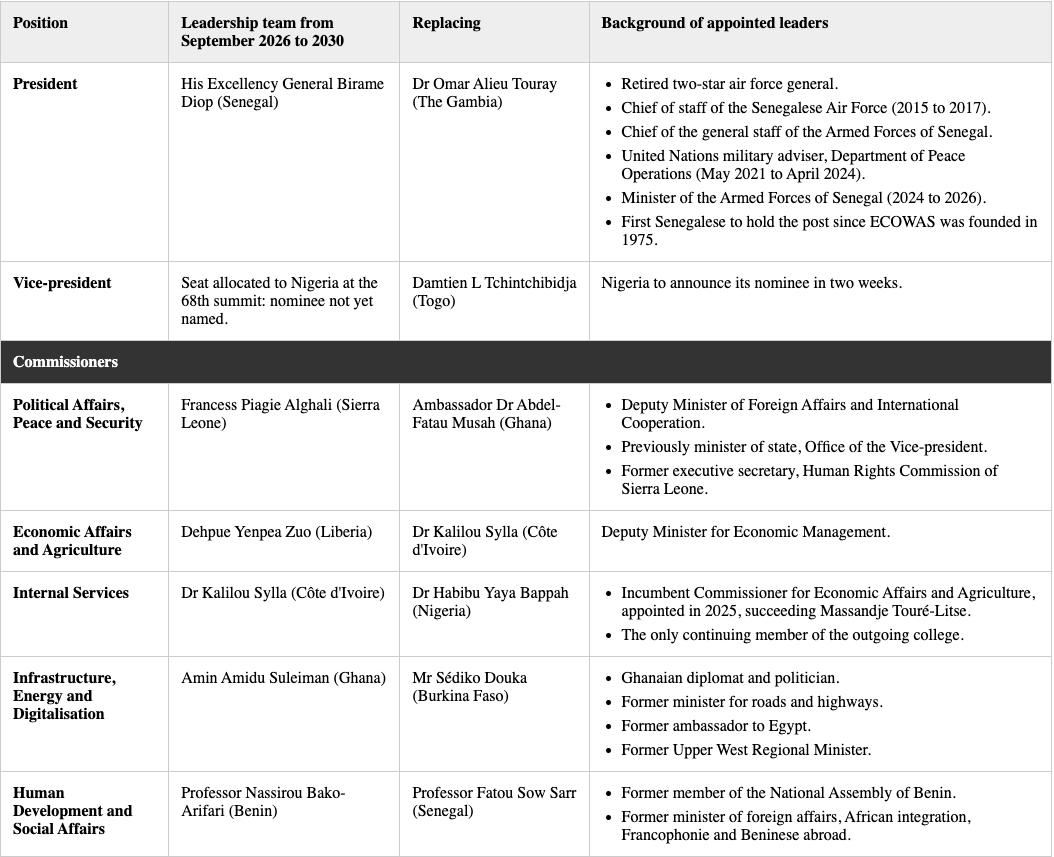
Faye’s chairship will coincide with the first year of a Senegalese-led ECOWAS Commission, as General Birame Diop was appointed commission president for 2026 to 2030. Francess Piagie Alghali of Sierra Leone was named Commissioner for Political Affairs, Peace and Security.
|
Incoming ECOWAS Commission leadership
|
The incoming commission leaders, whose tenure starts in September 2026, inherit an organisation facing crises of confidence and relevance following successive unconstitutional changes of government and worsening violent extremism in the Sahel, with its spillover. These upheavals triggered the organisation's fragmentation when Mali, Burkina Faso and Niger withdrew from ECOWAS in January 2025 and formed the Alliance of Sahel States (AES) in September 2025.
While ECOWAS has achieved marked success from its regional mobility agenda and economic integration efforts, the incoming commission must improve relations with AES members and enhance the relevance of the bloc by addressing violent extremism and political instability in member states.
Rethinking fragmented plans
A major decision at the 69th summit was the endorsement of the revised roadmap for a 1 650-strong counter-terrorism brigade in the ECOWAS Standby Force, which should be fully operational in July 2027. While such a force is long overdue, it faces structural challenges to be resolved by the incoming commission with the ECOWAS authority.
First, ECOWAS tends to compartmentalise violent extremism along sub-regional lines rather than as a region-wide challenge. This has forced so-called affected states to deploy troops and resources, while those deemed unaffected remain reluctant to contribute. Notably, violent extremism in Mali, Burkina Faso and Niger has long been regarded as a Sahel problem rather than a West Africa one.
ECOWAS compartmentalises violent extremism sub-regionally rather than region-wide
That framing suppressed appetite for a collective ECOWAS response and pushed the affected states, together with Mauritania and Chad, to establish the G5 Sahel Joint Force in 2017. Chronically under-resourced, the force failed to yield results and was ultimately superseded by the AES and its Unified Force, a mechanism launched in December 2025 to combat terrorism in AES countries. However, it faced similar weaknesses.
The dormant Accra Initiative, also established in 2017, was to address the spillover of extremist threats to the coastal countries of Ghana, Côte d’Ivoire, Togo and Benin. The initiative failed to make headway because it did not confront the threat holistically.
The Boko Haram crises followed suit. Although it affected Nigeria and Niger alongside Cameroon and Chad, it was managed as a Lake Chad Basin problem rather than one needing an ECOWAS-wide response in partnership with the neighbouring REC i.e the Economic Community of Central Africa States (ECCAS). This led to the reactivation of Lake Chad Basin Commission and the Multinational Joint Task Force. In each case, ECOWAS supplied political endorsement and diplomatic backing for resource mobilisation, but the sub-regional framing and limited intelligence sharing foreclosed a holistic strategy.
The planned counter-terrorism brigade is a chance to break that pattern, but only if troops and funding are provided collectively. Benin, Côte d'Ivoire, Ghana, Nigeria, Senegal and The Gambia have signalled willingness to contribute. The remaining member states must do likewise, since the threat could go beyond the frontline countries. As violent extremism spreads across the continent, the African Union must finalise the African Standby Force’s specialised counter-terrorism unit to support the ECOWAS brigade.
Secondly, ECOWAS must go beyond bolstering its brigade to partnering with the African Union to provide technical and financial support to the AES Unified Force. ECOWAS has already identified cooperation with AES as pivotal to preserving regional mobility and economic exchanges and to the success of its brigade. But is the development is ironic for the AES, which has long had to deal with extremism without meaningful ECOWAS intervention.
The African Union must finalise the African Standby Force’s specialised counter-terrorism unit
The brigade became an ECOWAS Commission priority in 2023 following the coups in Mali, Burkina Faso and Niger. These rapidly spilt over, with extremist activities becoming entrenched from the Sahel to coastal countries and increasing convergence with Lake Chad Basin extremist groups.
The ECOWAS special envoy on counter-terrorism was appointed in July 2023, when the situation had become dire. The move came too late, as Mali, Burkina Faso and Niger announced their withdrawal from ECOWAS a month after the December 2023 summit, forming the AES on 16 September 2024.The brigade could, therefore, seem to AES states as a containment force, thereby deepening grievances with ECOWAS.
Consequently, the brigade can be successful only if the operational strategy is aligned with that of the 6 000-strong AES Unified Force. This involves providing technical and financial support to the force to degrade extremists from within, thereby addressing deep-seated grievances against ECOWAS for its reluctance to respond in the Sahel until AES countries withdraw. This take into account that the brigade’s operational theatre borders countries where the problems are rooted and ECOWAS has no control.
Preventing the whitewashing of coups and democratic subversions
The incoming commission must rebuild the credibility of ECOWAS normative frameworks and responses. This is because the AES effect engendered an ECOWAS that is less resolute in its response to unconstitutional changes of government and democratic subversions.
ECOWAS violated its supplementary act by lifting Guinea’s sanctions after the junta won the election
Notably, when the Guinea-Bissau coup occurred in November 2025, ECOWAS did not display its usual strong stance against coups. This was because the event took place after the official withdrawal of AES members in January 2025. ECOWAS, at its December 2025 summit, rejected the one-year transition proposal by the junta and threatened to impose economic and financial sanctions if it wasn’t withdrawn. The junta resisted and retained its transition roadmap. A constitutional referendum is scheduled for 30 August 2026 and general election for 6 December 2026.
At the recently concluded ECOWAS summit, no sanctions nor threat of sanctions were voiced to deter violations. Rather, ECOWAS noted ‘efforts underway in Guinea-Bissau to conclude the country’s political transition’. Although the interim military president and prime minister are barred from running in the upcoming election, elements of the military and their proxies may run because the coup-to-ballot pathway has been normalised by the Guinea precedent.
ECOWAS, like the AU, lifted all sanctions on Guinea after the junta ran for and won the election. This violated Article 12 of the Supplementary Act A/SP.13/02/12 on Sanctions Against Member States that Fail to Honour their Obligations to ECOWAS. The act stipulates that the perpetrators of coups and their accomplices shall not stand for presidential office in their member states and that ECOWAS and its members shall not recognise governments that obtained power this way.
In the past, ECOWAS pressured juntas to organise elections, which they never contested, leaving room for civilians to run and win. The precedent set by the Guinea situation erodes the credibility of ECOWAS's normative framework and highlights a more cautious body bent on preserving relations with incumbents.
ECOWAS’s inability to address military coups can be attributed to a failure to address governance deficits by incumbent democrats proactively. Since July 2024, successive ECOWAS summits have made no reference to the review of the 2001 Supplementary Protocol on Democracy and Good Governance, a process it initiated in 2021 after the Guinea coup.
Following several consultations, a final draft was developed in 2023. Senior commission officials confirm that finalisation of the revised protocol has stalled due to objections from member states to presidential term limits, injunctions against constitutional manipulations and enforcement mechanisms. These were the issues that halted the protocol review in 2015.
The new commission must work with ECOWAS leaders to address the growing impression of double standards within the organisation through strong accountability measures for incumbent democrats as for juntas. The new commission will be only as effective as the strength of ECOWAS authority backing. But it has the potential to inject new ideas and strategies into the ongoing ECOWAS effort to rebrand itself and achieve a fully integrated community of peoples in a peaceful, prosperous region.