AU Summit 2026: security realities amid reform and justice pursuits
The significance of AU summits depends less on ambitious decisions and declarations but on coordinated and sustained implementation.
The 39th Ordinary Summit of the African Union (AU) Assembly, held on the 14th and 15th February 2026 in Addis Ababa, produced 39 decisions, 18 declarations and 2 resolutions. These were across six thematic areas – peace and security, governance, economic integration, institutional reform, health and humanitarian affairs and historical justice.
Following the 2025 theme of reparations, which was elevated to a decade theme, the 39th Summit followed the 2026 theme ‘Assuring sustainable water availability and safe sanitation systems to achieve the goals of Agenda 2063’. While water and sanitation were addressed numerous times, the summit clearly sought to advance both the reparatory justice agenda from last year and pressing continental security priorities. Beneath the 59 commitments lie a familiar tension: ambitious pronouncements meet persistent implementation gaps, as the AU navigates compounded conflicts, political instability and external pressures.
Most states present
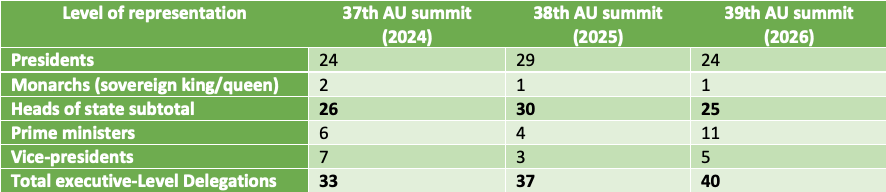
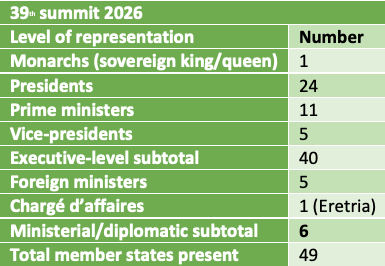
Attendance at the 39th summit reflected moderate political engagement. Based on AU sources and compiled data, 49 of the AU’s 55 member states were represented in some capacity. Forty delegations were headed by a monarch, president, prime minister or vice-president. About 51% of active membership was represented by a president or monarch.
While executive-level participation remained consistent with that of previous summits, presidential attendance declined, suggesting greater delegation to prime ministers or vice-presidents (only in a few countries do prime ministers hold ultimate executive power). This indicates sustained institutional engagement with AU processes but a more limited presence of heads of state at the AU Assembly. The higher presidential turnout at the 2025 summit is probably linked to AU Commission leadership elections.
|
Representation in 2024, 2025, 2026 summits
|
As with the 38th summit, six countries remain suspended and unrepresented, although the composition of the six was different. Two countries had their suspension lifted – Gabon and Guinea-Conakry – and two countries replaced them for unconstitutional changes of government – Madagascar and Guinea-Bissau. President Brice Oligi Nguema of Gabon and President Mamady Doumbouya of Guinea-Conakry made their debuts as presidents following post-coup transitions. Several other countries were represented at ministerial or diplomatic level.
Forty summit delegations were headed by a monarch, president, prime minister or vice-president
Despite fewer presidents, the 40 executive-level delegations indicate that member states remain attentive to continental developments, particularly as the summit addressed ongoing conflicts, governance challenges and institutional reform.
Leadership and institutional continuity
The summit elected President Évariste Ndayishimiye of Burundi chairperson of the AU Assembly for 2026, succeeding Angola’s João Lourenço, a move from southern to central Africa representation. Ghana’s John Dramani Mahama assumed the first vice-chairperson position, with Tanzania’s Samia Suluhu Hassan second vice-chairperson. The third vice-chairperson seat – from the northern region – is yet to be confirmed. Completing the bureau composition for 2026 is the outgoing chair – Angola – as rapporteur. Unlike in previous years, regional disputes did not affect the bureau formation, allowing continuity and institutional memory at the AU highest level.
The 39th summit was also the one-year mark since Mahmoud Ali Youssouf assumed office as AU Commission chair. In his first year, he emphasised peace and security as the foundation for development, including strengthening conflict prevention tools and advancing operational readiness of the Africa Standby Force (ASF). His agenda also prioritises sustainable financing, promoting economic integration through the Africa Continental Free Trade Area, bolstering coordination with regional economic communities and advancing youth empowerment and digital transformation initiatives.
Peace and security agenda
Security dominated the 39TH summit agenda, reflecting the AU’s pressing operational realities. Sudan remained the most urgent concern, with ongoing hostilities despite repeated calls for ceasefires, unhindered humanitarian access, and inclusive Sudanese-led process. The Peace and Security Council (PSC), chaired by Egypt, convened ministerial-level discussions on Sudan and Somalia, while eastern Democratic Republic of the Congo (DRC) drew attention through Togolese-led mediation coordination. The summit largely reaffirmed prior positions rather than introducing new mechanisms, highlighting the persistent gap between declaratory commitments and actionable intervention.
Resurgence of unconstitutional changes of government in 2025, with ongoing terrorism in the Sahel, Horn of Africa and Lake Chad Basin, reinforced the AU’s zero-tolerance stance and the need for coordinated, multilayered responses.
A proposal to increase the AU Peace Fund endowment from US$400 million to US$1 billion was noted
Most of the proposed initiatives of Kenya’s President William Ruto – champion for institutional reforms – were adopted. Reforms and strengthening peace and security include a harmonised African governance and peace and security architectures (APSA) implementation plan team and enhanced PSC coordination with the Committee of Ten and African UN Security Council members (known as the A3). It also encompasses an AU early action guideline and the functionalisation of the African Court of Justice. Ruto’s proposal to increase the AU Peace Fund endowment from US$400 million to US$1 billion was noted but not actioned, signalling a lack of consensus at the moment.
The summit also decided to hold an extraordinary meeting in Luanda, Angola under the theme ‘Strengthening mechanism for conflict prevention and resolution in Africa’ to advance continental preventive diplomacy and crisis response. A landmark achievement was the adoption of the memorandum of understanding on the ASF, formalising rapid deployment and operational coordination with regional communities.
|
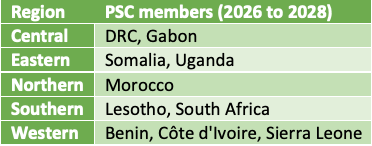
PSC members (2026 to 2028)
|
Historical elections to the PSC also marked progress, with six new members from the 10 seats up for election and Somalia securing membership for the first time, reflecting frontline representation in continental decision-making.
Perhaps the most notable departure from draft Assembly decisions to final decisions was the final decisions’ omission of the request for the AU Commission, through the AU Office of the Legal Counsel, to prepare draft administrative guidelines for the implementation of the criteria in Article 5 of the PSC Protocol and Article 16 governing relations with RECs, with a report to be submitted at the 2027 summit. This sharply indicates the commitment deficiencies for implementation of agreed upon criteria in Article 5(2). In-fact this omission stalls progress towards fulfilling Article 5(4) that stipulates a periodic review by the Assembly on whether PSC members continue to meet the requirements to be a PSC member.
Territorial integrity
Territorial integrity remains a central principle as per Article 3(b) of the AU Constitutive Act, yet the continent in 2025 faced complex international dynamics. United Nations Security Council Resolution 2797, adopted in October 2025, endorsed Morocco’s 2007 autonomy proposal for Western Sahara. While the United Nations has formally addressed this, the AU continues to recognise the Saharawi Arab Democratic Republic as a member despite only 18 AU member states (roughly 32%) currently maintaining active recognition of SADR.
Security dominated the summit agenda amid Sudan and eastern DRC conflicts, coups and terrorism
Israel’s recognition of Somaliland prompted AU condemnation and summit leaders reiterated that no external actor would unilaterally alter the territorial configuration of a member state. The AU’s relative silence on 2797 highlights the limits on continental engagement, where greater international consensus exists while continental support remains mixed as AU member state recognition for the Saharawi Arab Democratic Republic has gradually declined.
At the same time, the AU is strengthening Africa’s strategic positioning in global diplomacy. Institutional reforms have included the creation of a dedicated G20 unit to advance the continent’s collective engagement in international fora. This is alongside a mandate for a five-member expert panel to draft a harmonised African foreign policy framework. Yet foreign policy remains a conceptual prerogative of sovereign states rather than the responsibility of multilateral or intergovernmental organisations.
Therefore, the AU’s intergovernmental structure does not seamlessly provide a conceptual or operational environment for a fully cohesive foreign policy – a challenge the five-person panel will have to navigate. Even advanced regional organisations such as the European Union stop short of defining a single foreign policy, highlighting the structural hurdles and sovereign sensitivities the AU faces in aligning member state priorities while asserting Africa’s collective interest globally.
Africa and the global economy
The summit addressed Africa’s role in the global economic system while advancing a broader agenda on historical justice. The Comprehensive Africa Agriculture Development Programme (CAADP) was reaffirmed as a flagship Agenda 2063 programme, the AfCFTA digital identity and traceability systems were launched and the African Medicines Agency (AMA) became fully operational. The declaration also supported climate action, water investment, biodiversity protections and infrastructure financing, reflecting the AU’s water sustainability theme to strengthen the continent's economic integration.
Historical justice and reparation also featured prominently at this Summit. Decisions recognised slavery, deportation and colonisation as crimes against humanity, endorsing the Algiers Declaration (2025). This primarily Ghana-led campaign has also resulted in the UN General Assembly Resolution A/80/L.48 on March 25 2026 declaring trafficking of enslaved Africans and racialised chattel enslavement of Africans as the gravest crime against humanity. They led to mechanisms including the AU Committee of Experts on Reparations and planning for the proposed Pan-African committee on memory and historical truth. While largely medium term, these initiatives signal efforts to integrate economic diplomacy and historical justice efforts into Africa’s contemporary engagement, even though their impact will depend on sustained implementation.
Ambitious declarations, persistent gaps
Security dominated the summit agenda amid Sudan and eastern DRC conflicts, coups and terrorism. Despite the abovementioned reforms, implementation gaps remain, due not least to member states’ willingness and interests, continued inconsistency in AU-regional community coordination, financing and external pressures. On the other hand, territorial integrity debates reveal tensions among states, AU principles and external pressures, a perennial crisis that continues to test AU effectiveness.