Fragmented security allows terrorists’ cross-mobility across Lake Chad and Sahel
As Islamic State affiliates extend their reach, states must find ways to share intelligence and cooperate, despite political fractures.
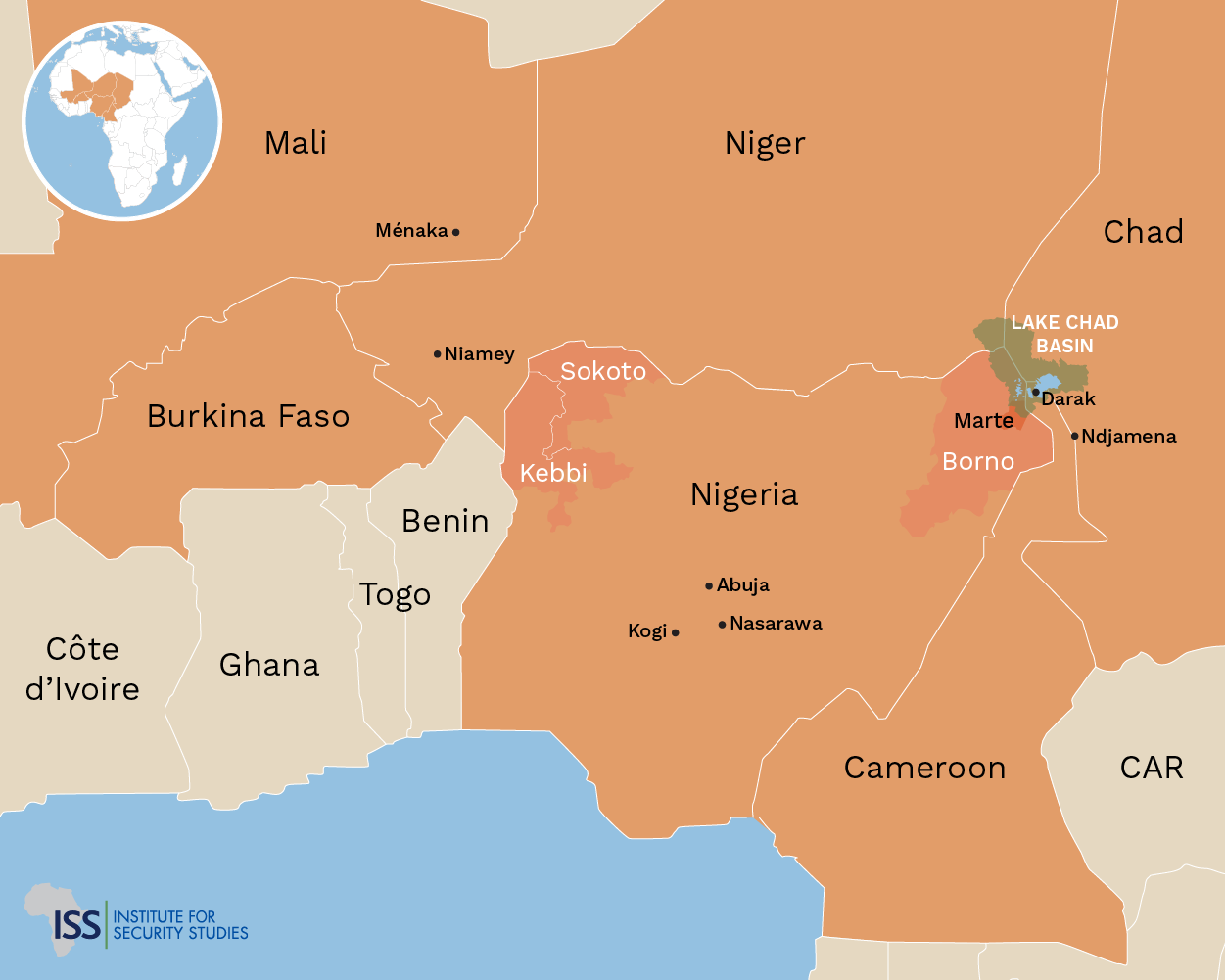
Islamic State West Africa Province (ISWAP) has resolved to send 100 fighters to reinforce Islamic State Sahel Province (ISSP) in Ménaka near Mali’s border with Niger, defectors communicating with current fighters told ISS Today. This comes months after ISSP retreated from the area when Malian forces regained control.
Such decisions by ISWAP’s Shura Council, made at a recent meeting, pose a major challenge to Lake Chad Basin and Sahel counter-terrorism operations – and show an organisation both under pressure and extending its reach.
Anti-insurgency structures in each region are not designed to match ISWAP and ISSP’s cross-regional mobility. ISSP operates mainly across the Mali-Burkina Faso-Niger border area, where the al-Qaeda-linked Jama’at Nusrat al-Islam wal-Muslimin is also active. Success will depend on cooperation between these governments.
One defector quoted a fighter who attended the Shura Council meeting as saying: ‘They [ISSP] are having problems [in Ménaka]’ – meaning the group needed support. Fifty more fighters were heading to Nasarawa in Nigeria’s North Central, hundreds of kilometres from ISWAP’s Lake Chad stronghold, he said – the second such deployment to Nasarawa since 25 fighters were sent there last year.
|
Countries in the Lake Chad Basin and Sahel regions affected by Islamic State affiliates
|
ISWAP is reportedly operating a sleeper cell in Nasarawa, which would operate like its Kogi cell in North Central Nigeria, which was responsible for a 2022 church attack in southwestern Nigeria and participated in the 2022 Abuja prison attack.
Meanwhile, Institute for Security Studies (ISS) field data shows ISSP fighters have crossed into North West’s Sokoto and Kebbi states from southern Niger, complicating security in the Nigeria-Niger-Benin tri-border area where multiple armed groups are active.
The cross-regional mobilisation fits a pattern initially seen in January when ISWAP helped ISSP deliver coordinated attacks on Niger’s Diori Hamani International Airport and Air Base 101, with drones and fighters deployed from Lake Chad and northwestern Nigeria.
ISSP conducted initial surveillance and reconnaissance before ISWAP joined, according to ISS sources. Sources at the Multinational Joint Task Force (MNJTF), Lake Chad’s regional security structure, said they observed ISWAP fighters moving westward weeks before the attacks, corroborating information from Borno sources. Yet Niger was unprepared for the attack, highlighting a problem with forces operating in silos.
Anti-insurgency structures in each region are not designed to match ISWAP and ISSP’s cross-regional mobility
Islamic State (IS) African affiliates operate within a structured network, first coordinated by now reportedly dead ISWAP leader Habib Yusuf, son of Boko Haram founder Mohammed Yusuf and a United States (US)-designated terrorist, with a seat on the global IS Shura Council. This matters in understanding the integrated structure of IS terrorism in Africa.
At the same time, the recent ISWAP Shura Council meeting’s resolutions suggest the group is strained in the Lake Chad Basin and desperate to squeeze civilians for financing and new recruits, following May’s US-Nigerian strikes that killed commander Bukar Mainok and around 200 fighters. It resolved to raise livestock and fishing taxes by 50% in areas under its control.
Then it lowered its minimum recruitment age from 17 to 15, concentrating a new drive on Tumbuma in Borno, near Darak, a recent ISWAP target. A Borno source told ISS Today the group was pressed for cash to finance its activities, including for fuel, equipment and members’ healthcare – critical for holding its force together.
The group also lifted travel restrictions to its island strongholds for foreign jihadists, previously imposed because US-Nigerian strikes made movement too dangerous. Foreign jihadists have been key to ISWAP’s capabilities. Ten trainers – from Iraq, Chechnya and Libya – arrived this month to train ISWAP fighters on anti-aircraft weapons, reportedly newly acquired from Sudan to respond to increasing aerial threats.
Squeezed by US-Nigerian strikes, ISWAP is taxing civilians harder and lowering its recruitment age to rebuild
Defectors said combatants reported constant fear and frequent sightings of aircraft overhead. Although the US has withdrawn most of its around 200 troops, Nigeria’s military says this won’t affect its momentum. Both countries say intelligence sharing will continue.
A former Boko Haram leader, now a defector helping Borno State draw fighters out of the group, describes a jihadi worldview that doesn’t process setbacks the way outsiders assume. After Boko Haram lost ground in 2014 and 2015, he recalls commanders asking each other how they could be losing when they were fighting for God. The answer was not to question their mission but to blame losses on the late Abubakar Shekau’s deviations from ‘pure’ Islamic teaching.
The logic in which defeat is a correctable error produces an inherently resilient organisation resistant to demoralisation. They believe they’re being tested and that, if they strive, eventual victory is guaranteed by God’s will.
That worldview aligns with IS’ Africa-wide ambition – overcoming states and organising affiliates across sub-regions into a coordinated network under a global state.
Any sustainable progress against common threats across these regions needs cooperation. At an ISS-MNJTF meeting in N’Djamena this month, African Union (AU) sources said there were few, if any, formal channels for cross-regional intelligence sharing with the Sahel.
Junta-led Mali, Niger and Burkina Faso are out of the AU and ECOWAS, hampering cooperation
Junta-led Mali, Niger and Burkina Faso are out of the AU and Economic Community of West African States, hampering cooperation with equally threatened neighbours. Instead, the three focus on localised defence and have recently built a unified joint force. ECOWAS has also announced a regional counter-terrorism force, further fragmenting security.
Despite political fractures, a standing intelligence channel and response plans must be created. The AU’s Special Envoy for the Sahel, Burundian President Évariste Ndayishimiye, could facilitate a pragmatic working arrangement by leveraging the AU’s institutional foothold in the Sahel through the Mission for Mali and the Sahel.
This mission convened a high-level dialogue on cooperation and stabilisation between West African and Sahelian stakeholders in April, before AU Commission Chair Mahmoud Ali Youssouf’s July visits to Bamako and Ouagadougou. Their diplomatic goodwill should be turned into concrete security plans.
International donors and partners should make cross-regional stabilisation programming – acknowledging problems common to the Lake Chad Basin and Sahel – a condition of support where relevant, to encourage inter-state collaboration.
Locally, while strengthening security to prevent ISWAP’s largely coercive recruitment plans, Nigeria needs a dedicated intelligence-led operation to counter sleeper cells outside the North East.
For permission to re-publish ISS Today articles, please email us. In South Africa, News24 has exclusive rights to republish ISS Today articles. In Nigeria, Premium Times has exclusive rights to republish ISS Today articles.