PSC agenda: thematics are crowding out urgent country crises
Thematic topics strengthen Council’s conflict prevention and response, but their dominance risk sidelining evolving and emerging insecurities in member states.
The provisional programme of work of the African Union (AU) Peace and Security Council (PSC) for June 2026 reflects a growing trend in the PSC’s monthly agenda. It contained 11 items, five of which were thematic, two country-focused and the remainder was on RECs coordination, notably through the AU-RECs mid-year coordination meeting and regional meetings with sister organs.
The April and May 2026 agendas, with four and six thematics, respectively, of 11 items, are similarly symptomatic of the longstanding trend of thematics dominating in PSC tabling. An Institute for Security Studies (ISS) study, covering January 2023 to June 2026, confirms the tendency.
Longstanding trend
The ISS’s analysis was solely on longitudinal observation of programmes of work. The analysis shows that, whether discussed or not, an item on the PSC agenda indicates the Council’s interest and intention to prioritise it. The preliminary results of the study, based on descriptive statistics and a qualitative approach, indicate the PSC’s growing focus on thematics. During the study period, the Council tabled 449 items, an average of nearly 11 items a month. Thematics (254 items) constituted 56.6%, while country situations accounted for only 22.9%, followed by PSC regional/multilateral engagements, which made up 20.5%.
Recurrence of item categories on PSC agenda January 2023 to June 2026 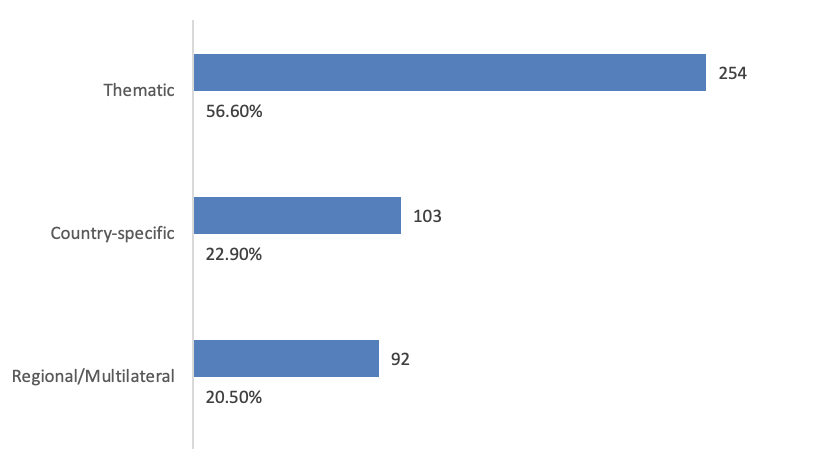 Source: PSC Report analysis of PSC programmes of work available on the AU Political Affairs, Peace and Security department digital repository Source: PSC Report analysis of PSC programmes of work available on the AU Political Affairs, Peace and Security department digital repository
|
An item on the PSC agenda indicates the Council’s interest and intention to prioritise
The surge in thematics was also observed in the Amani Africa study, which analysed PSC’s programmes of work and meeting outcomes from its inception in 2004 through the 2022 calendar year. While these were marginal on the Council’s agenda at its onset, they reached a 50-50 distribution with country situations in 2019. Amani’s analysis shows how country situations accounted for 90% of the PSC’s first three years, leaving only 10% for thematics. Numbers of thematics rose considerably in 2021 and 2022, accounting for 56% in 2022.
Thematic discussions have centred on three main issues ― governance challenges and post-coup political transitions, PSC institutional affairs to foster coordination with AU structures such as African Peace and Security Architecture and counter-terrorism. This distribution demonstrates the PSC's efforts to address crucial issues, including unconstitutional changes of government and violent extremism, which have topped continental peace and security challenges over at least the last five years. The PSC also seeks stronger coordination among AU peace and security structures and robust working methods to discharge its mandate effectively.
Recurrence of thematic items on PSC agenda January 2023 to June 2026 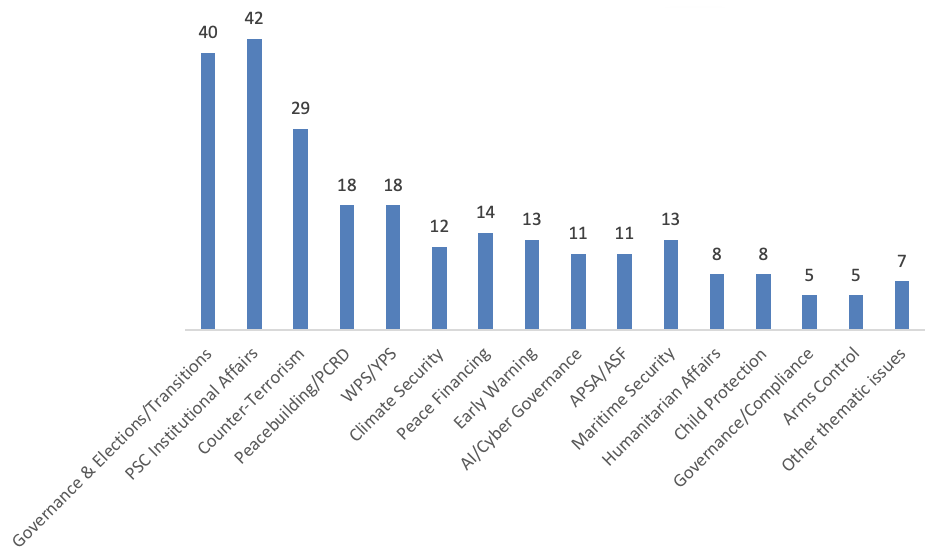 Data source: PSC Report analysis of PSC programmes of work available on the AU Political Affairs, Peace and Security department digital repository Data source: PSC Report analysis of PSC programmes of work available on the AU Political Affairs, Peace and Security department digital repository
|
The top country situations tabled involved Somalia, Sudan and South Sudan. Over the study period, Somalia was tabled 20 times, while Sudan and South Sudan were discussed 19 and 12 times respectively. The Democratic Republic of the Congo was considered nine times. Prolonged and grave crises in these countries justified their repeated tabling.
Recurrence of country situations on PSC agenda January 2023 to June 2026 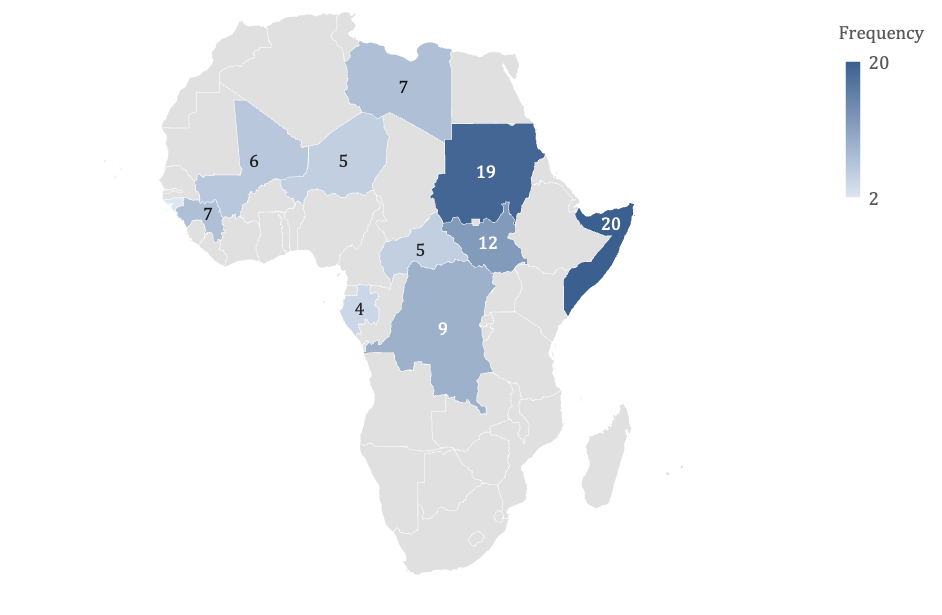 Data source: PSC Report analysis of PSC programmes of work available on the AU Political Affairs, Peace and Security department digital repository Data source: PSC Report analysis of PSC programmes of work available on the AU Political Affairs, Peace and Security department digital repository
|
Reasons for thematic dominance
Three reasons explain the dominance of thematic items. The first is operational. The PSC tabling obeys a yearly provisional programme agreed on by its 15 member states, thus monthly programmes of work reflect items planned annually. These include statutory meetings with African Peace and Security Architecture pillars, supporting organs and entities such as RECs, the European Union and the United Nations. Even though chairs and the entire Council have flexibility in crafting monthly planning, the execution of the agreed-upon yearly planning remains a must.
Over 42 months, thematics constituted 56.6% of agenda items, with country situations at 22.9%
The second is that thematic issues may be discussed at any time, whereas country situations are influenced by occurrences and the gravity of circumstances that usually prompt PSC consideration. In principle, internal peace and security remain the responsibility of member states. Some, based on the sovereignty principle enshrined in the AU Constitutive Act, oppose the PSC's consideration of their cases.
For instance, Niger President Mohamed Bazoum rejected the PSC’s good offices to de-escalate the palace dispute with the current transition leader before the coup in July 2023. Similarly, Cameroon and others have felt they have the capacity to handle their crises without an official PSC tabling. Moreover, in line with the subsidiarity principle, certain country situations, such as that of Guinea Bissau, are routinely addressed by RECs.
The third is the chairs' interest, whether regional or national. Sudan has been on the PSC agenda regularly due to its ongoing instability ― at least since the 2019 coup. However, Egypt, during its recent PSC membership, showed particular interest in discussing lifting that country’s AU suspension. Nigeria has prioritised counter-terrorism with other important regional and continental peace and security issues, such as maritime piracy. Thus, despite operational constraints, chairs’ interest, mostly in issues affecting their countries and regions, and their influence among peers play a huge role in crafting the monthly programmes.
Improving the PSC agenda
Over two decades, the PSC has expanded its agenda to broader peace and security challenges. This demonstrates the organ’s willingness to anticipate crises effectively, strengthen its prevention capacity and address the drivers of continental instability holistically. However, by doing so, generic thematics have superseded evolving and emerging country situations that require immediate attention and stronger focus. Challenges include agenda overload, especially when implementation capacity remains limited and coordination lags.
Agenda overload is a challenge, especially when capacity remains limited and coordination lags
Overexpansion might not yield the desired impacts for PSC and AU member states. A targeted approach in agenda setting would help. The Council has had difficulties in tabling some obvious crises, such as Cameroon and electoral violence in Tanzania. In such conditions, sovereignty has been prioritised over non-indifference, allowing the PSC to examine crises across the continent despite their primary character as ‘home affairs’.
Should AU pro-sovereignty stances persist, the agenda would be further focused on generic themes to avoid friction with uncooperative member states. Ultimately, this could affect PSC crisis anticipation and response capacity. To avoid this, the Council should coordinate further with the AU Assembly and the Permanent Representatives’ Committee to sensitise member states on the value of tabling country situations. Close sessions could be proposed, especially for the most sensitive cases.