Beyond election observation: the preventive role of the Peace and Security Council
Treating elections as technical events limits the Council’s preventive mandate and risks normalising democratic backsliding.
Electoral challenges in Africa often appear procedural. Yet the deeper issue is the gradual hollowing out of political competition through legal, constitutional and administrative instruments. The African Union (AU) Peace and Security Council (PSC) continues to treat elections as technical exercises rather than crucial political junctures. These reinforce an environment in which procedural compliance substitutes for democratic legitimacy. The distance between the AU Commission (AUC) report on election observer missions and the PSC’s decisions documented during the 2025 election suggests this gap is not narrowing.
Elections short on democratic substance
With 12 member states holding elections observed by the AUC chairperson’s elections reports across two semesters, there is a growing divergence between the frequency of elections and the quality of democratic governance. While most polls in 2025 were peaceful and on schedule, others unfolded amid restricted civic space, opposition exclusions and legal manoeuvres consolidating incumbency. Indeed, more than 60% of countries hosting elections in 2025 are classified by Freedom House as ‘not free’.
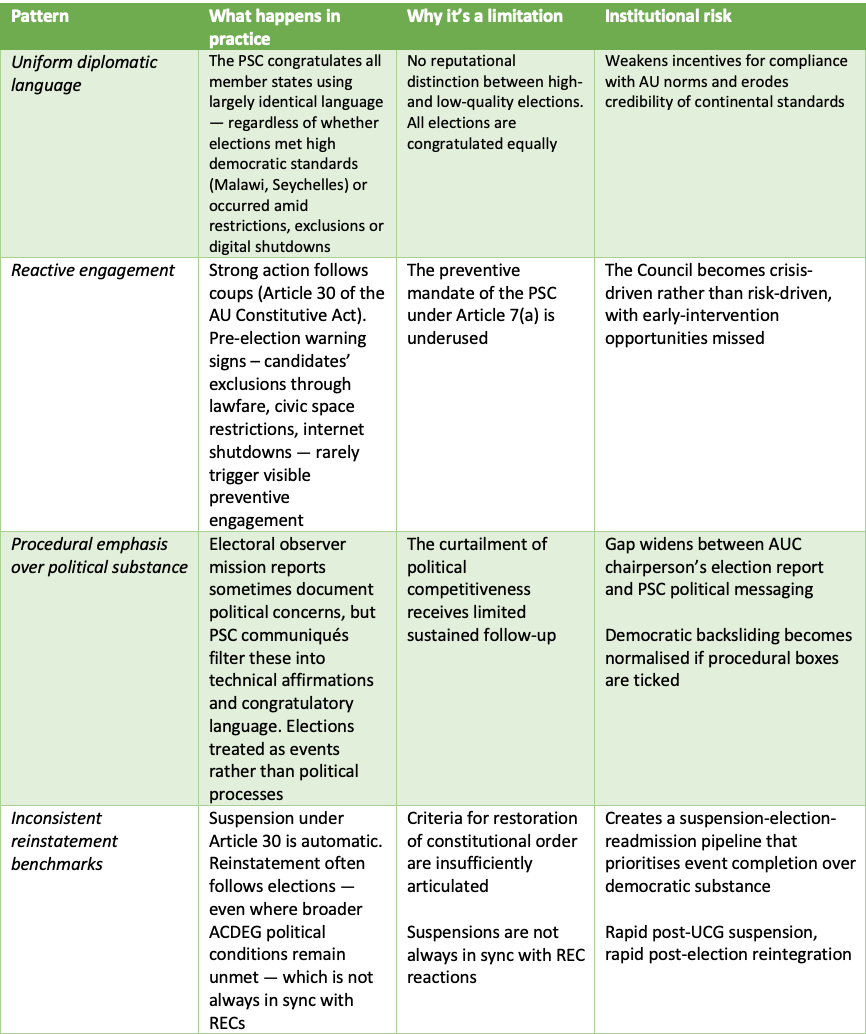
The erosion of political competitiveness was evident. In Côte d'Ivoire's October presidential election, the AU mission noted that some stakeholders raised concerns that certain leading political figures were not able to participate in the elections due to disqualification of candidacy. This was recorded in the AUC report. The communiqué of the 1 327th PSC meeting simply congratulated Côte d'Ivoire without qualification. This pattern reveals a Council that has developed language for military coups but not for manifestations electoral lawfare. Language reacting to the former is often more blatant.
In Tanzania, the same report noted election-related violence leading to internet challenges and curfews lasting several days and urged the government to release political detainees. It was recommended that member states be discouraged from shutting down the internet during elections, describing such actions as both an electoral management risk factor and a violation of citizens’ right to freedom of information. While the corresponding PSC decision condemned hate speech and violence, it did not address internet shutdowns. This is significant. Digital access to information is integral to a free, fair and credible election and need not be suspended to address hate speech nor misinformation.
Heightened contestation can end in conflict and if elections lack credibility, grievances accumulate
Although Tanzania is not a state party to the African Charter of Democracy Election and Governance (ACDEG), it is to the African Charter on Human and People’s Rights. In its 30 October 2025 statement, the African Commission on Human and People’s Rights expressed concern over the nationwide ‘digital blackout’. It recorded that internet shutdowns violate Article 9 of the charter and that any restriction must be lawful, necessary and proportionate.
Elections following unconstitutional changes of government (UCGs) are similarly concerning. While Article 30 of the AU Constitutive Act mandates suspension following coups, reinstatement frequently occurs after elections, even where coup leaders contest and win. This is contrary to ACDEG Article 25(4).
In Guinea, an ACDEG state party since 2011, a military transition occurred in 2021, with Mamady Doumbouya emerging the central figure. Four years later, a referendum facilitated a return to constitutional order, leading to Doumbouya’s election as president. The 1 327th PSC meeting communiqué commended Guinea for ‘successful organisation’. While the swift management of the transition was highlighted, the communiqué did not mention the quality of the democratic process or adherence to ACDEG’s ratified principles on lifted suspensions.
Such a rapid suspension following a coup and equally quick reintegration after an election are not always aligned with the practices of regional economic communities. In Guinea, for example, both the Economic Community of West African States (ECOWAS) and the AU lifted their suspensions within two months of Doumbouya’s election. By contrast, in the ongoing Madagascar transition, the AU moved promptly to suspend the country, while it remained a full member of the Southern African Development Community (SADC). Should elections proceed as scheduled in 2027, it is likely that the AU will again favour rapid integration, reinforcing a suspension-election-readmission pipeline that is not consistently mirrored across regional bodies.
Together these developments widen the gap between AU normative frameworks and political realities. The AUC chairperson’s reports reflected the technical services and at times the democratic deficiencies of observer missions, whereas the PSC will filter them out due to greater political considerations, thus falling short of mentioning subversive traits.
|
Patterns in PSC African election decisions
|
Implications for the PSC
A core mandate of the PSC is preventative. Article 3(4) of the PSC Protocol identifies among its objectives the promotion of democratic practices, good governance and the rule of law. This is fortified by Article 7(1: m), which states the responsibilities as follow-up within the framework of its conflict prevention responsibilities and progress towards the promotion of democratic practices, good governance, the rule of law, protection of human rights. This seeks to ensure promotion of democratic practices. Article 7(1: a) empowers the Council in conflict prevention, not only in crisis response.
Electoral governance has been treated primarily as a political and governance issue managed by the AUC chairperson. Yet the interlinkages and cascading consequences between governance and security are undeniable. Elections are moments of heightened political contestation that are often the last trigger for conflict. When they lack credibility, grievances accumulate. Even in the absence of immediate violence, unresolved disputes erode institutional trust and increase long-term risks to stability.
Legalised authoritarian practices – facilitated through constitutional design, judicial manoeuvrers and managed elections – can produce quieter but deeper instability. When citizens perceive electoral avenues as incapable of producing change, political competition may shift outside institutional channels. Governance and public service delivery deficits are repeatedly identified in AU reporting as structural drivers of UCGs.
Even without violence, unresolved disputes erode institutional trust and increase risks to stability
The AUC chairperson’s July-to-December 2025 report coup section was notably candid. It acknowledged that ‘existing instruments have not always proven sufficient to deter such actions before their occurrence’ and that the cycle ‘shows no sign of abating in the short- and medium term’. The PSC’s response was to reiterate the AU zero-tolerance policy. The report highlighted limitations in the existing toolkit, yet the PSC merely reaffirmed its standard zero-tolerance stance at its 1 327th Meeting, revealing a disconnect. For the PSC, this raises an institutional question: should electoral issues continue to be addressed primarily through observation and post-election communiqués or be treated more consistently as structural risk factors within the Council’s preventive mandate?
Strengthening the preventive function
The PSC does not require new authority ― its founding instruments already provide scope for deeper preventive engagement. Article 6(b) empowers it to undertake preventive diplomacy. When pre-election assessments reveal structural risks, the Council should request targeted briefing, issue guidance grounded in ACDEG principles or mandate discreet engagements through the Panel of the Wise as per Article 11(1) of the its protocol.
Kenya illustrates the evolution of AU engagement in elections and preventive diplomacy. In 2007 and 2008, post-election violence claimed more than 1 000 lives. The AU’s response was reactive and relied on the Panel of the Wise, while the European Union deployed an observer mission and anticipated conflict in its report. Waiting to intervene post-crisis proved costly. By the 2013 Kenyan election, the AU had adopted the long-term observer methodology, deploying observers six weeks before voting. Observers mentioned the political environment, engaged parties, assessed constitutional implementation and liaised with the electoral commission. The involvement of Chairperson Nkosazana Dlamini-Zuma and the electoral observer mission leadership of former presidents Joachim Chissano (2013) and Thabo Mbeki (2017) reinforced the AU’s political weight, reducing the risk of overt violations.
In 2017, expanded consultations, pre-election risk messaging and calibrated engagement through the Supreme Court annulment of presidential results limited tension escalation. Kenya holds three lessons for the PSC: early presence enables early warning, coordinated continental messaging shapes political behaviour and long-time observation combined with high-level preventive diplomacy link accountability with conflict prevention.
Early presence enables flashpoint identification and coordinated messaging shapes political behaviour
However, Kenya is not a universal template. In the Democratic Republic of the Congo’s 2018 elections, the AU deployed a mission of 80 long- and short-term observers. But the process was undermined by widespread irregularities, suppression of opposition campaigning, logistical obstacles and violence that observers could not prevent nor resolve. The outcome was contested and the post-election environment tense, demonstrating that while expanded observation strengthens monitoring and signalling, it cannot on its own overcome structural political incentives nor deep-rooted institutional weaknesses.
Building on these lessons, underlying principles remain broadly applicable: early, sustained presence enables timely identification of electoral flashpoints; coordinated messaging through the observer mission reports, the biannual reports and the PSC communiqués shapes political behaviour, and the combination of long-term observation with high-level diplomacy reinforces accountability while mitigating conflict risks.
Embedding these practices systematically within PSC processes would allow the Council to move beyond reactive, event-driven responses and procedural oversight, addressing the deeper structural drivers of destabilising elections evident across 2025 electoral cycles. These include legalised authoritarianism, constrained civic space and manipulated electoral frameworks.
By ultimately institutionalising preventive management more substantially, the PSC can enhance its role from technical observer to a preventive guardian of democratic integrity and political stability. This would send a clear signal to member states that adherence to continental norms is both monitored and consequential.