Why military gains are not weakening the ADF in eastern DRC
The ADF’s resilience stems from kidnapping economies, forced recruitment and governance failures that military operations cannot address alone.
Multiple blows continue to shatter security in war-torn eastern Democratic Republic of the Congo (DRC), with the deadly Ebola outbreak adding to the Congo River Alliance (AFC)/M23 conflict and stalled peace processes.
Meanwhile, the Islamic State-aligned Allied Democratic Forces (ADF) is intensifying attacks against civilians, expanding its geographic reach and exposing the limits of a military strategy that has failed to weaken it. Despite nearly five years of joint Congolese-Ugandan efforts under Operation Shujaa, areas cleared of ADF fighters are routinely re-infiltrated in weeks.
There are several reasons for this, including the group’s strong internal succession system, which enables next-in-line officers to quickly take over when leaders are neutralised. Alleged state collusion, weak governance and scant civilian protection fuel the problem.
Shujaa focuses on joint offensives from mobile combat to human intelligence, aimed at dismantling ADF command structures and restoring state authority in occupied areas. Beyond kinetic approaches, the goal is to enable civic stabilisation, including road construction and abductee rehabilitation. But its strategy remains reactive, with limited integration of pre-emptive approaches capable of neutralising the ADF.
|
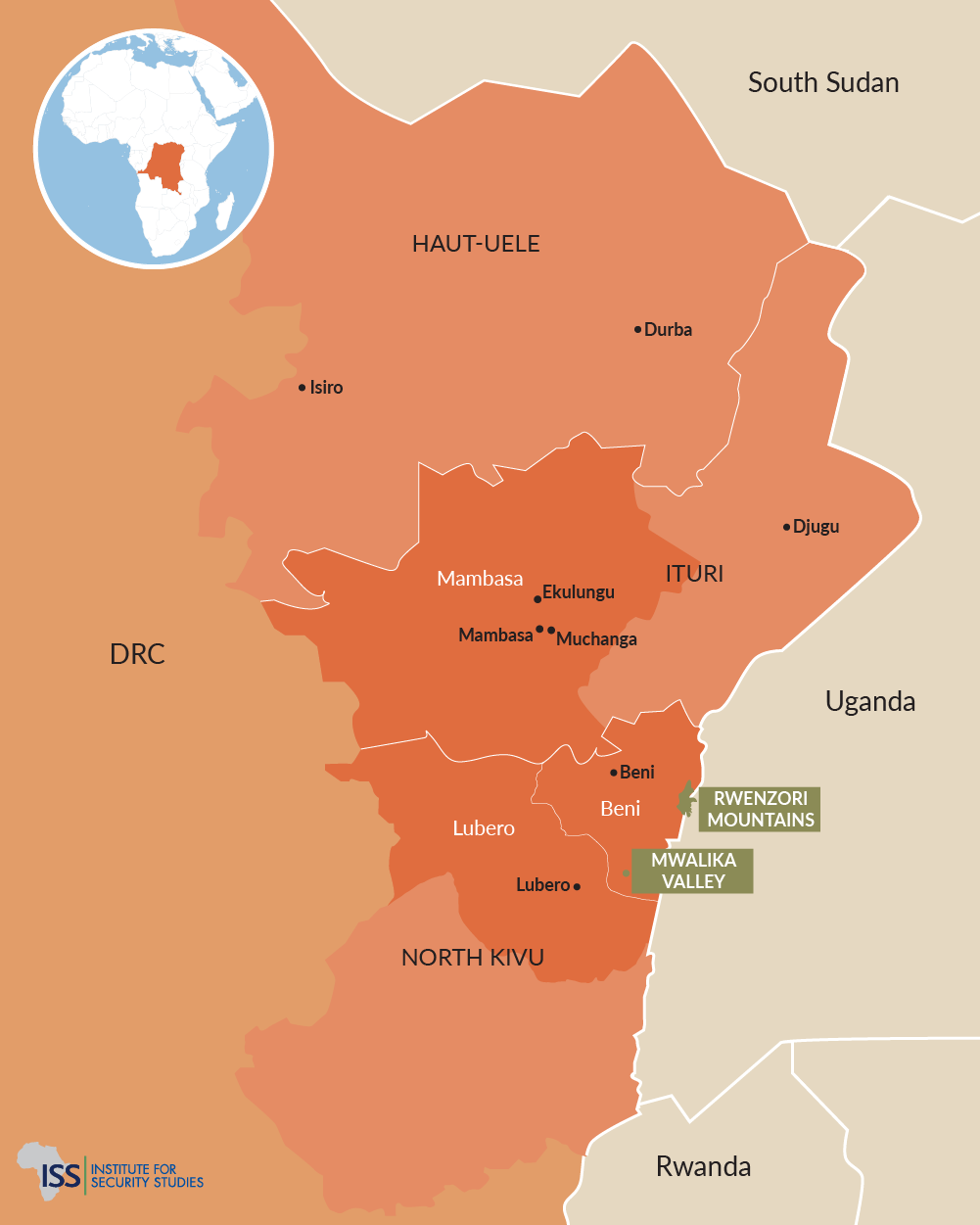
Expanded reach of the ADF in eastern DRC
|
The March killing of senior ADF commander Defender Kasibandi (Salongo) is one of a series of tactical successes that have not delivered sustained security gains. In the same month, Operation Shujaa’s efforts in Mambasa against ADF fighters travelling with captives resulted in seven hostages being freed. Two days later, artillery strikes killed at least 14 ADF militants.
Despite this, attacks are escalating. On 11 March, ADF fighters attacked the Muchacha, Ituri, mining site, killing at least 17 civilians and destroying homes. They occupied the site until 23 March, with the death toll rising to 67 and multiple civilians abducted. On 14 March, militants ambushed Armed Forces of the DRC (FARDC) soldiers travelling towards Mambasa, killing seven and a major.
In early April, ADF fighters raided Bafwakoa village in Mambasa, killing over 70 civilians, burning homes and vehicles, and triggering mass displacement. Shujaa forces freed around 200 hostages – many frail and ill – from a camp along the Epulu River. But in early May, attacks across Mambasa and North Kivu killed at least 50 civilians in a week.
Despite five years of Operation Shujaa, areas cleared of ADF fighters are routinely re-infiltrated in weeks
These outcomes highlight that eliminating leaders has thus far caused only short-term disruption. Mid-level ADF commanders serve as pre-designated successors, so removing a senior figure triggers an internal handover rather than a power vacuum. Also, the most influential ADF figures remain uncaptured. Commanders like Ahmad Mahmood Hassan (Abwakasi) now lead some of the most violent factions.
ADF attacks also intensify after military operations, targeting communities perceived as cooperating with FARDC or Shujaa. However, the group’s resilience lies beyond its disciplined, hierarchical command structure and modus operandi. A key contributor is the strategic failure of military efforts, which instead of containing the ADF, have contributed to its geographic spread and regeneration.
Institute for Security Studies (ISS) analysis previously identified the ADF’s core areas of activity in North Kivu’s Grand Nord and Ituri. But Congolese research institute Ebuteli reports that sustained military pressure has produced two observable shifts: geographic dispersal into Haut-Uele province, and a tactical transition away from fixed strongholds towards mobile, decentralised operations.
Two factors drive the ADF’s ability to adapt and disperse. First, the group generates illicit revenue through ransom demands. According to Ebuteli, in March alone, a record 544 civilians were abducted in Mambasa – over 400 of them by the ADF – with ransoms of between US$2 500 and US$10 000. While more kidnappings may indicate financial strain, they also show the ADF’s capacity to exploit a lucrative, low-risk conflict economy – signalling resilience rather than decline.
Military pressure has led to ADF’s geographic dispersal and transition to mobile, decentralised operations
Second, abductions serve as a terror tactic and help grow the ADF’s numbers. Amnesty International reveals that women and girls are forced to marry fighters, with ‘wives’ used as incentives to sustain combat motivation and loyalty. Victims, including boys, are subjected to religious indoctrination, sexual violence and torture, and once indoctrinated, are trained as fighters and spies.
ISS fieldwork reveals that the ADF’s armed capacity is aided by local, national and regional political actors, with some FARDC elements reportedly involved. This is compounded by institutional strain. FARDC Ituri head Lieutenant General Johny Luboya N’kashama flags critical shortfalls in personnel, food rations and welfare funding for the families of fallen soldiers. Armed groups exploit these conditions to encourage collusion and defection.
Despite Shujaa’s military and diplomatic gains, its strategic limitations allow ADF attacks to persist. The DRC’s fragmented security landscape means political priorities and resources are redirected to tackling other groups, such as the AFC/M23. And Shujaa’s largely reactive efforts point to gaps in military intelligence and operational coordination.
Shujaa’s dual function is also hard to ignore. Kinshasa requires the wholesale degradation of the ADF, while Kampala has used the operation to push the group from its borders while protecting oil infrastructure and expanding trade routes into eastern DRC.
Regional cooperation must expand to include disrupting cross-border networks sustaining the ADF
A fundamental reorientation of strategy across four interconnected areas is required.
First, affected areas need a more sustained state presence, particularly mining zones and transport corridors. The primary aims must be to disrupt illicit taxation systems, strengthen civilian protection and re-establish security and service delivery.
Second, regional cooperation must move beyond military coordination to include disrupting the cross-border networks sustaining the group.
Third, demobilisation and reintegration of former ADF combatants and better protection of civilians are needed to weaken the ADF’s coercive recruitment systems. This must be accompanied by greater engagement of security forces with communities and the development of counter-narratives to disrupt ADF recruitment.
Fourth, governance failures, social grievances and political manipulation must be addressed. The February provincial forum in Beni started tackling these issues. Political and administrative authorities, defence and security forces, community leaders and civil society actors reaffirmed their commitment to tackling the ADF problem. But meaningful change requires sustained political will.
If the factors driving ADF attacks persist, tactical military gains will continue to mask deepening structural failures.
For permission to re-publish ISS Today articles, please email us. In South Africa, News24 has exclusive rights to republish ISS Today articles. In Nigeria, Premium Times has exclusive rights to republish ISS Today articles.