African champions chart the way on the Global Compact for Migration
Seventeen African nations are pioneering global migration management, but will others follow their lead?
Over 80% of people migrating in Africa remain on the continent, often straining neighbouring countries. Yet migration also drives economic growth, development and regional integration.
Migration remains globally contested, as heightened tensions in South Africa show.
The 2018 Global Compact for Safe, Orderly and Regular Migration (GCM) was adopted to foster international cooperation, protect migrant rights and manage complex migration flows. For Africa, it offers a structured, cooperative framework to address irregular migration while maximising the benefits of human mobility.
The GCM enables countries to reframe migration from a risk-laden challenge into a development pathway, aligned with the African Union (AU) Migration Policy Framework for Africa and Agenda 2063.
Yet, as member states gear up for the GCM’s second International Migration Review Forum (IMRF) in New York this month, progress in implementing the GCM worldwide is sluggish. Africa’s experience can change that.
Since 2020, countries have volunteered to serve as GCM Champions to help steer its objectives and meet targets. In April 2026, 17 African GCM Champions assessed their progress and prepared a joint contribution to the IMRF. These were Chad, Egypt, Ethiopia, Eswatini, The Gambia, Ghana, Guinea‑Bissau, Kenya, Lesotho, Malawi, Mali, Morocco, Nigeria, Rwanda, Senegal, Sierra Leone and Zimbabwe.
|
Global Compact for Migration champion countries
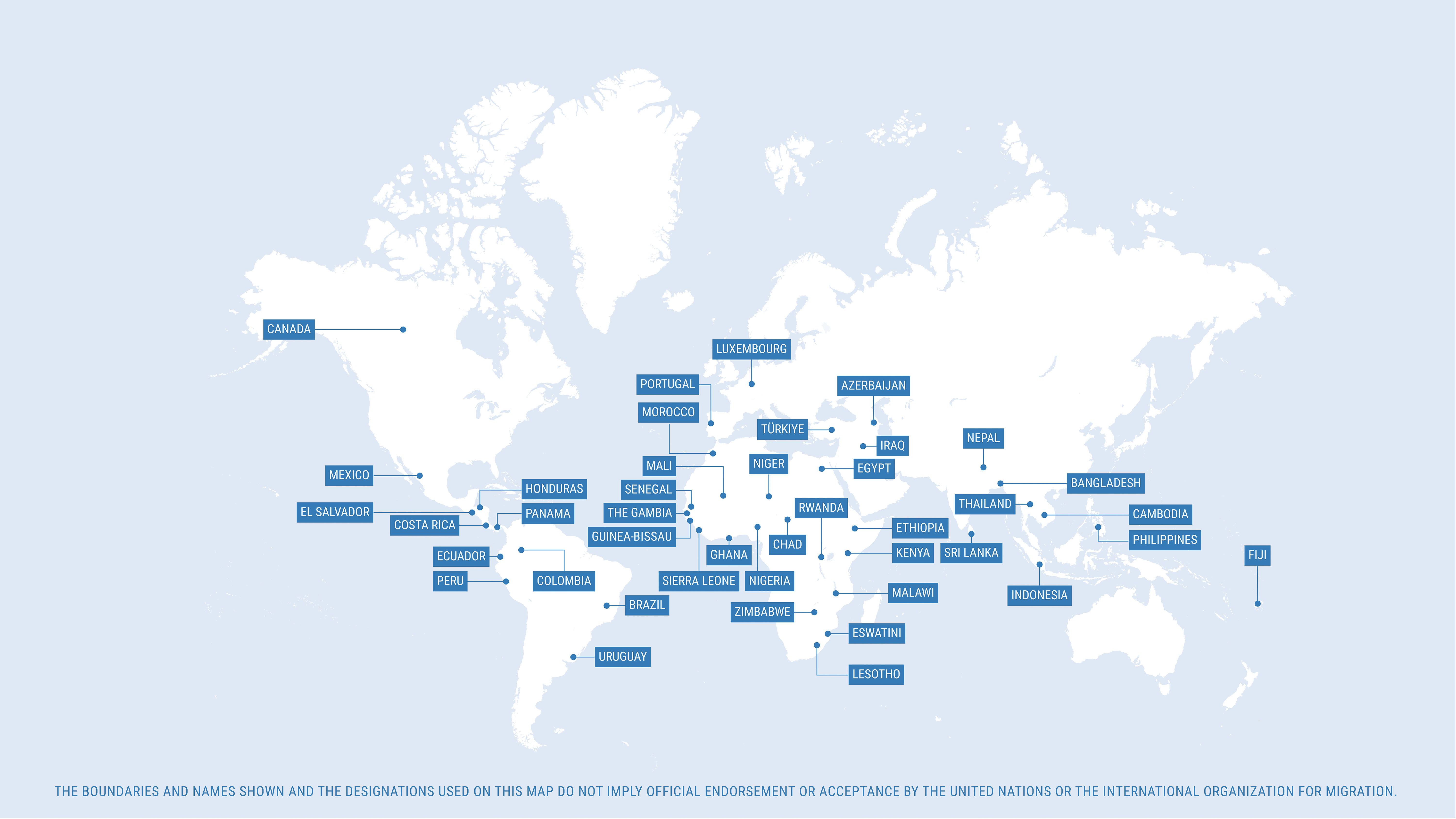
Source: United Nations Network on Migration
|
They reaffirmed Africa’s role in implementing the GCM, demonstrating the global compact’s practical application and providing a case study for member states at IMRF 2026. Examples include skills partnerships linked to national transformation agendas, like those Ghana has adopted for technical and vocational training and efforts to connect national labour migration policies to regional free movement arrangements in West, East and Southern Africa.
Five key issues should shape the New York debates.
First, better migration governance requires accurate data. Strengthening the evidence base by consolidating national migration data systems and agreeing on a small, shared set of indicators would improve accountability under both the GCM and AU frameworks.
Objective 1 of the GCM calls on states to collect and use accurate and disaggregated data as a basis for evidence-based policies. Migration debates are often driven by perceptions of crisis, while evidence on who is moving, in what conditions, and with what outcomes can be partial or contested.
To address this, African countries are investing in national migration profiles, data hubs and frameworks. Some are conducting studies on migration, climate change and gender to inform policy. Still, informal crossings, internal mobility and displacement are poorly captured, migration information is dispersed, and gaps exist between data production and policymaking.
Migration remains globally contested, as heightened tensions in South Africa show
At IMRF 2026, African states must advocate for greater support to consolidate national migration data systems, rather than create new initiatives, and develop a small African ‘core indicator’ set for GCM and AU reporting.
Second, there is a need for regular pathways and enhanced labour mobility. African countries are testing circular migration programmes, skills partnerships linked to national development, and closer alignment between labour migration policies and regional free movement regimes in West, East and Southern Africa.
Yet these schemes cover only a few thousand workers annually, compared to tens of millions of young Africans entering or aspiring to enter the labour market each year.
Experience in West and East Africa suggests that labour mobility schemes are more sustainable when they build on regional free movement frameworks, are co-designed and co-owned by origin and destination governments, and are explicitly linked to skills development and inclusive growth. This points to the value of moving beyond scattered, short-term pilots towards fewer, larger, and better-designed mobility partnerships with clear safeguards and monitoring.
Third, protection, dignified return and sustainable reintegration remain systematically weak. In some countries, like Mali, national reintegration guidelines link individual support to vocational training and local development.
Labour mobility schemes reach only thousands annually, compared to tens of millions of young Africans entering the market
Regional efforts show that safe evacuation and temporary protection for vulnerable migrants are feasible when responsibilities are shared among countries, including through platforms like the Pan-African Forum on Migration. Several states are strengthening asylum and internal displacement frameworks and piloting alternatives to immigration detention.
However, African states are grappling with the challenge of ‘projectisation’ of complex, long-term tasks. Financing for return and sustainable reintegration often remains short-term and project‑based. When projects end, systems can struggle to sustain gains, and migrants and communities may lose existing support.
Sustainable reintegration and alternatives to detention are most effective when embedded in broader governance and development plans, with multi-year resources and measurable outcomes at both the individual and community levels. IMRF 2026 offers an opportunity for member states and partners to signal support for return and sustainable reintegration not built on fragmented projects.
Fourth, the diaspora and climate are two significant, underused levers. The World Bank estimates remittances to Africa at nearly US$100 billion annually, but diaspora engagement often centres on symbolic events or small-scale initiatives.
African countries are starting to institutionalise diaspora representation, promote tourism and skills transfer, and explore African-anchored diaspora investment instruments. These initiatives require careful design, including realistic expectations for diaspora communities and adaptive financial products.
African countries are leading the way – the rest of the world should ensure the next GCM phase is anchored in practice
Climate-related mobility is another area where Africa is starting to act, but gaps remain. Mobility can be both a risk and an adaptation strategy, depending on how it is governed. National strategies must reflect climate mobility and align migration governance with disaster risk reduction and adaptation frameworks.
Developing tools for climate-sensitive labour pathways, planned relocation and social protection in affected areas is key. These issues could be prioritised in discussions on GCM implementation.
Finally, Africa’s experience with implementing the GCM shows that migration governance is inherently political and involves balancing different policy objectives. Decisions on regular pathways, skills development, diaspora engagement and sustainable reintegration all affect labour markets, public finances and social cohesion.
There are no perfect solutions to the challenges in the migration governance space. Yet, at the IMRF and beyond, honest discussions about risks and trade-offs, and crafting workable solutions, are essential to the GCM’s credibility.
African countries are leading the way. The rest of the world should pay heed and ensure the next phase of the GCM is firmly anchored in practice.
The opinions expressed in this article do not necessarily reflect those of the IOM, the ISS, its trustees, members of the Advisory Council or donors. Authors contribute to ISS publications in their personal capacity.
For permission to re-publish ISS Today articles, please email us. In South Africa, News24 has exclusive rights to republish ISS Today articles. In Nigeria, Premium Times has exclusive rights to republish ISS Today articles.