A youth-focused strategy can curb transnational organised crime in Africa
Across Africa, youths are increasingly drawn to illicit economies due to a lack of meaningful access to education, employment and political participation.
Youths account for more than 60% of the population and this is projected to exceed 75% by 2030. This bulge is incommensurate with current socioeconomic and political investments and trajectories on the continent. As a result, criminal economies and networks offer the economic agency, social identity and belonging that states and formal markets have failed to provide.
This is the security challenge that the African Union (AU) Peace and Security Council (PSC) must confront with renewed urgency as it holds regular annual sessions on strategies to combat transnational organised crime (TOC). These include the commemoration of Africa Amnesty month in September for the voluntary surrender of illicit arms and weapons. While the PSC recognises the diversity of TOC, most of its attention is on arms and weapon flows, which are often directly linked to violent insecurity.
Attention is limited on the nexus between insecurity and other TOCs that enable and sustain the worsening episodes of violent extremism and armed activities in the Sahel, Central Africa and East Africa. Crimes that undermine state stability include human and drug trafficking, migrant smuggling, cybercrime, and illegal logging, mining and fishing, with youth at the frontlines. Hence, understanding youth susceptibility and involvement is central to any credible African strategy to combat the scourge and attain durable peace and stability.
Drug trafficking and abuse
In Sierra Leone and Liberia, for example, youths are caught in the web of both drug trafficking and abuse. The drug of primary concern is kush, a synthetic substance driving a public health crisis, particularly among youth. More worrying is the involvement in drugs of children as young as 12 – both male and female.
Crimes such as human and drug trafficking, cybercrime and illegal mining threaten state stability
Research by the Institute for Security Studies indicates that the drug is produced in Sierra Leone using chemical compounds, including synthetic cannabinoids and nitazenes. Liberian and Sierra Leone gangs collaborate with transnational drug cartels to smuggle, distribute and trade drugs.
In Liberia, substance abusers are colloquially called ‘zogos’, both a description and a stigmatisation of people living on the margins of society, particularly disadvantaged youth experiencing homelessness and destitution. More than 70% of Liberia's 5.9 million population are under 35 and about 57% of school-aged children are out of school. Most live in chronic poverty and are unemployed, which drive hopelessness and substance abuse.
Ghettos where substance users congregate have proliferated across the capital in publicly visible places such as cemeteries, abandoned buildings, beaches, under bridges and improvised settlements near police stations, schools and residential communities. This reflects the state's growing inability to manage, contain or reverse the crisis. These ghettos offer an abode to many homeless, idle and addicted youths, but also harbour large and growing youth gangs, thereby creating a convergence of drug and gang cultures.
The ghettos are organisational hubs and hideouts for gangs. Armed with machetes, knives and, increasingly, firearms, these groups rob, extort and peddle protection services to paying customers. During elections, political elites have recruited gang members as enforcers to intimidate voters and disrupt opposition activities. Gangsterism and criminality among youths could further jeopardise Liberia’s stability in the medium- to long term.
Glamour of cybercrime
A parallel and equally significant trend is the normalisation of cybercrime as a viable livelihood strategy among youngsters. Cyberfraud is rising among youth in Ghana and Nigeria, for instance, as they are the most digitally connected citizens.
Ghettos offer an abode to homeless, idle, addicted youths, but also harbour large youth gangs
In Nigeria, this has produced so-called ‘hustling kingdoms’ ― informal cybercrime academies where youngsters are trained in digital fraud as if attending a vocational institution. These centres deploy sophisticated, diversified methodologies, including romance scams, advance-fee fraud, investment and lottery schemes, business email compromise and ransomware attacks, targeting victims globally.
The elderly are targeted disproportionately due to perceptions of greater trust and lower digital literacy. The scale of financial harm is substantial and increasingly involves sophisticated technical infrastructure. Emerging cybercrimes and the advent of artificial intelligence and cryptocurrencies are advancing way beyond international regulations, including the AU’s 2014 Convention on Cybersecurity and Personal Data Protection.
In Nigeria, confraternities are linked to cybercrime and protection racketeering. Nigerian confraternities, often called cults or secret societies, originated in the 1950s as university-based movements advocating liberation and social justice.
|
List of select confraternities in Nigeria
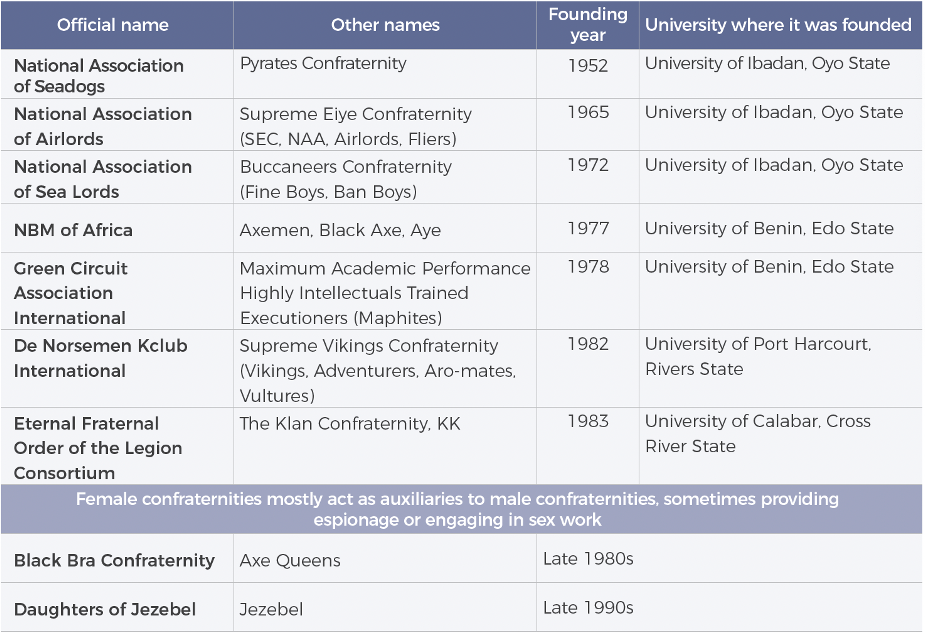
Source: ISS, Enhancing Africa’s Response to Transnational Organised Crime
|
Despite their diverse professional membership, these youth-driven confraternities have become largely synonymous with violence and crime. They have transformed over decades of economic marginalisation, the capture of leadership structures by criminal elements and the systematic instrumentalisation of confraternity members by influential state and non-state actors.
Bonded by oaths of secrecy and loyalty, these organisations have in recent years acquired global notoriety as transnational criminal networks, with members implicated in sophisticated and extensive cyberfraud, drug and sex trafficking and money-laundering. They operate across borders, exploiting local criminal markets and cooperating with indigenous criminal networks in host countries.
In 2017, Canadian authorities dismantled a money-laundering network estimated at US$5 billion involving syndicates linked to Nigerian confraternities. International Criminal Police Organization (Interpol) Operation Jackal III in 2024 seized assets worth US$3.5 million across 21 countries through operations targeting networks connected to these organisations. In South Africa between 2021 and 2025, joint operations involving the Hawks, Interpol and United States agencies made several arrests, including senior confraternity members.
Not all confraternity members are involved directly in crime, but the role of protection rackets ― enforcing agreements and resolving disputes in the criminal economy through mob loyalty ― makes uninvolved members structurally complicit. The revenues flow not always through deliberate design, but through the structural logic of criminal economies, into the coffers of extremist organisations and armed groups. This sustains instability.
Implications for the PSC
The growing allure of organised crime among desperate youths is a significant threat to Africa's stability. Where states have failed to invest, criminal economies thrive, with devastating results for governance, social cohesion and long-term security.
The PSC must champion the development of a comprehensive AU convention on transnational organised crime
Any counter-TOC strategy that focuses exclusively on enforcement and interdiction, however necessary, will not address the structural conditions that make organised crime the most rational economic option for millions of marginalised young Africans. Therefore, the PSC must press member states to adopt explicit youth investment commitments framed as peace and security imperatives, not merely as development aspirations.
The Council must move beyond rhetoric to redefine youth participation in peace, security and governance. It must work with AU youth ambassadors and Youthwise to engage youngsters in member states for early warning and counter-crime strategy design. This will ensure that young people are integral in formulating policies to address their vulnerability. Organised crime should be addressed in civic and peace education in schools to prevent the entrapment of youths in crimes packaged and justified as alternative economic opportunities.
Lastly, the PSC must champion the development of a comprehensive AU convention on transnational organised crime to promote harmonised national legislation, cross-border law enforcement cooperation, regional intelligence sharing and consistent disruption of criminal networks.