South Africa needs smarter visas, not just harder borders
A visa regime acknowledging the inevitability of some migration between neighbouring countries could affordably reduce irregular migration.
Most migrants labelled ‘undocumented’ in South Africa are in fact documented. They come from neighbouring countries through regular channels with passports, but overstay their permitted time or work without authorisation.
However, the government is under civilian pressure to stem migration. Its response focuses disproportionately on securitising borders and repatriating foreigners.
While modernising border infrastructure could regulate migration and facilitate trade, securitising is costly. It risks inhibiting legitimate travel and trade, directs public funds to private companies, and doesn’t prevent irregular migration. A visa regime that acknowledges that some migration between neighbouring countries is inevitable would be more effective.
South Africa’s migrant density (number of migrants to total population) is 4%; the global average is 3.6%. According to the 2022 census, 83.5% of the 2.4 million migrants in the country came from neighbouring and other Southern African Development Community (SADC) countries. Zimbabwe was the leading country of origin, comprising 48.5% of the total migrant population, followed by Mozambique (20%), Lesotho (10.9%) and Malawi (9.5%).
|
Percentage distribution of top 10 sending countries to South Africa, 2001, 2011 and 2022
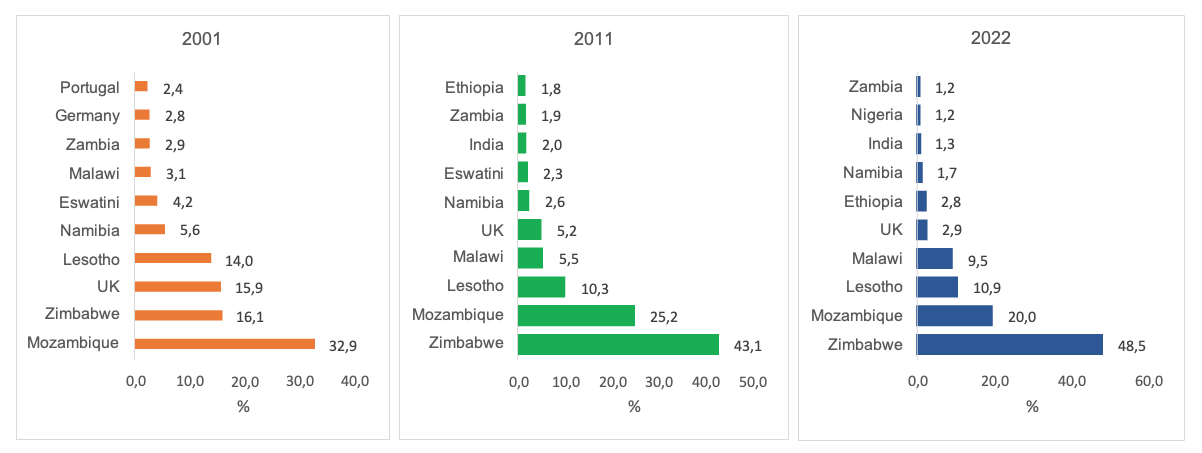
Source: Statistics South Africa, Census 2001, 2011 and 2022
|
South Africa allows visa-free entry for citizens from 22 African countries, including its neighbours. These citizens can visit for between 30 and 90 days, depending on their nationality. Given that most migrants arrive from visa-free countries via regular channels, securitised borders will not – and should not – prevent them from entering.
Globally, spending on border security has skyrocketed alongside rhetoric about strong borders. The sector was worth about $US48 billion in 2022 and was projected to reach $US81 billion by 2030.
In July, South Africa’s Department of Home Affairs (DHA) provided a timeline for a R12.5 billion public-private partnership to strengthen and modernise six land border posts. The project started in 2023, with completion set for 2030. Border security has been intensified through drones, surveillance technology and patrols, and infrastructure along the 4 862 km land border will be upgraded.
At the same time, Africa is working to establish the African Continental Free Trade Area and Free Movement Protocol. Full implementation would increase Africa’s gross domestic product by 10% and give South African businesses access to 1.4 billion consumers. These policies rely on border efficiency and reduced barriers to the movement of people and goods. Proposals to modernise borders are welcome, but risk slowing travel and trade if they aim to frustrate migrants.
In June, President Cyril Ramaphosa announced a five-point plan to crack down on immigration law violations, secure borders, strengthen the immigration system, close gaps in migration laws and policies, and collaborate with other countries. He established an Inter-Ministerial Committee on Migration (IMCM).
South Africa allows visa-free entry for citizens from 22 African countries, including its neighbours
Priority has been given to immigration law enforcement and labour inspection. On 6 July, DHA announced a 35% increase in immigration enforcement capacity. Hiring more personnel requires shifting money from other areas, which are yet to be disclosed.
IMCM quickly established dedicated immigration courts. Between 1 and 9 July, KwaZulu-Natal courts finalised 2 640 immigration cases for deportation. A court at Gauteng’s Lindela Repatriation Centre is being re-established, along with one in collaboration with the Airports Company.
Since June, tens of thousands of migrants have returned home. As of 11 July, 53 449 foreign nationals had been processed for deportation and repatriation. Repatriation is ‘voluntary’, whereas deportation is the formal expulsion from a host country.
Malawians comprised over 80% of returnees, followed by Zimbabweans and Mozambicans. Only 2 615 people had been repatriated beyond SADC to Nigeria (1 159), Kenya (431), Uganda (939) and the Democratic Republic of the Congo (86).
Is the Musina centre an attempt to build a refugee camp without the required parliamentary approval?
Most were processed at Musina near the Beitbridge border post with Zimbabwe. The government closed repatriation centres around South Africa and built a temporary processing centre in four days, 20 km from Musina. Operations began on 1 July, and by 13 July, over 20 000 people were processed through it.
DHA says ‘most’ people processed at the centre didn’t have valid passports or had overstayed their visas and permits. According to accounts on the ground, people were issued with five-year bans and declared ‘undesirable’, including some with valid documents allowing them to return.
Government says the centre is temporary and expects repatriations to decline. But researchers worry that it has used this opportunity to achieve a long-held goal of building a refugee camp without the required parliamentary approval.
The 2026 White Paper on Citizenship, International Migration and Refugees proposes establishing a single processing centre at the border, but this hasn’t been debated or legislated. Many civil society organisations (CSOs) warn against camps and are concerned about conditions inside the Musina centre. DHA says it reflects the country’s humanitarian obligations and describes the approach as ‘both firm and humane.’
In a 2017 White Paper, DHA acknowledged that a lack of pathways could lead to irregular migration
In a 2017 White Paper on international migration, DHA acknowledged that a lack of pathways could lead to irregular migration. If South Africa truly wants to reduce irregular migration, it should regularise migrants already inside the country and develop pathways for irregular migrants.
There are examples of this. In 2009, South Africa launched the Dispensation of Zimbabweans Project, which became the Zimbabwean Special Permit in 2014 and the Zimbabwe Exemption Permit in 2017. While around 178 000 Zimbabweans have renewed their permits and remained in the country, new dispensations were never issued.
Spain is one of Europe’s main receiving countries for overall immigration and irregular arrivals. On 30 June, it closed a regularisation window that allowed 1.2 million irregular migrants to apply for legal status.
A visa regime enabling some migrants to regularise their stay – under specific conditions or with quotas – holds the most potential to reduce irregular migration at a relatively low cost. It would also enable regional integration and free trade, and direct state resources to fighting real crimes and threats to South Africans.
For permission to re-publish ISS Today articles, please email us. In South Africa, News24 has exclusive rights to republish ISS Today articles. In Nigeria, Premium Times has exclusive rights to republish ISS Today articles.