New maritime task force puts Gulf of Guinea unity to the test
The Combined Maritime Task Force takes aim at piracy and other crimes affecting 26 diverse countries from Senegal to Angola.
Published on 24 June 2026 in
ISS Today
By
Martin Ewi
Senior Researcher, Transnational Threats and Organised Crime, ISS
A new rapid response force for the Gulf of Guinea has set its sights on preventing piracy and other maritime threats and protecting the region’s blue economy. Launched on 1 June, the Combined Maritime Task Force (CMTF) is a bold joint initiative led by six countries – Côte d’Ivoire, The Gambia, Ghana, Liberia, Nigeria and Sierra Leone.
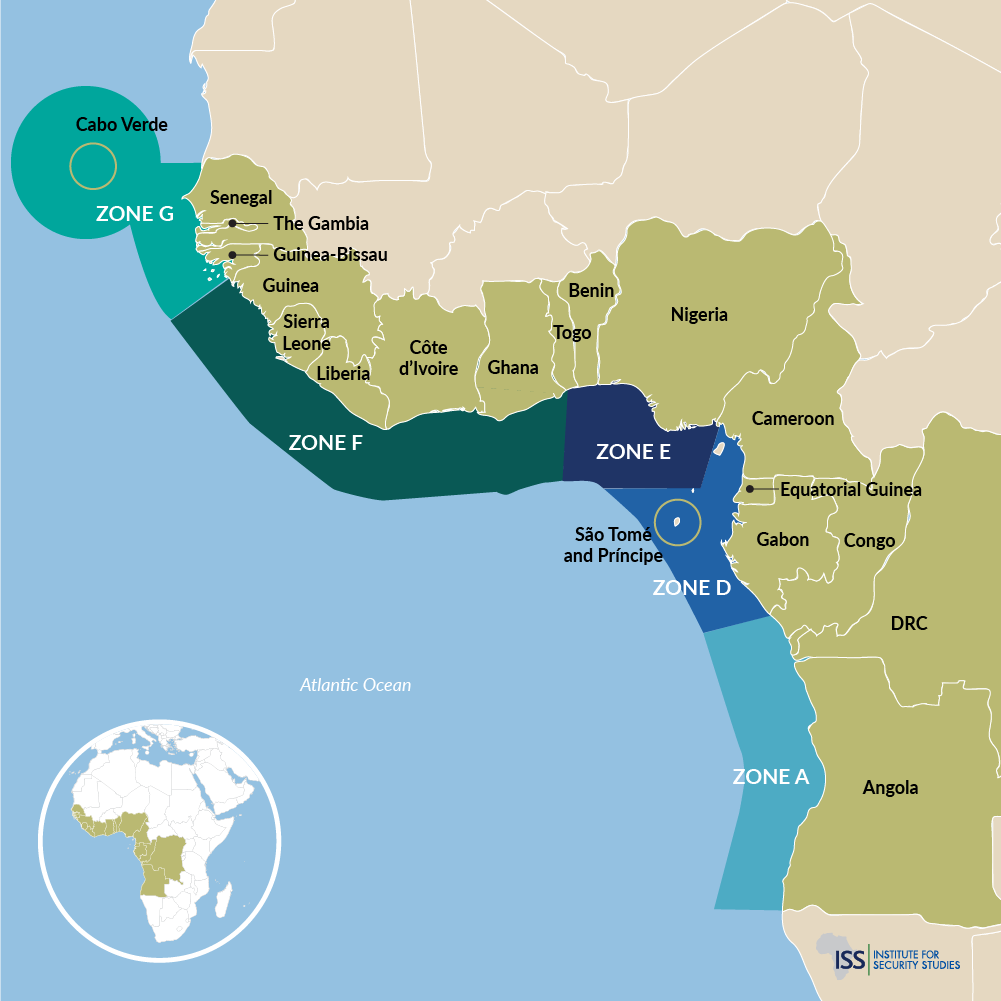
The CMTF covers 26 countries which have over 6 000 km of coastline, stretching from Senegal to Angola. Over the past decade, the Gulf of Guinea has become notorious for maritime crime and was once regarded as the world’s hotspot for piracy. The region also faces illegal bunkering, armed robbery, kidnapping, transnational organised crime, illegal fishing and terrorism.
Sustained regional efforts have curbed piracy in the Gulf of Guinea over the past few years. But recurring kidnappings and other violent attacks show that maritime insecurity remains a threat. These incidents disrupt trade and development, and erode investor confidence in the blue economy.
|
Gulf of Guinea countries and maritime zones
|
Headquartered in Lagos, Nigeria, the CMTF represents a renewal of member countries’ commitment to tackling these threats. The task force will undertake surveillance, interdiction, intelligence gathering, patrols, search and rescue, and other maritime security operations.
The CMTF is not the first regional maritime mechanism in the Gulf of Guinea. Notable among past efforts is the 2013 Yaoundé Code of Conduct, which governs cooperation among West and Central African states on piracy and other illicit maritime activities. But serious implementation challenges have impeded these initiatives, and the CMTF must draw lessons to avoid a similar fate.
CMTF Commander Commodore Mohammad Shettima told ISS Today that, ‘The task force is to complement and fill an important gap in the [Yaoundé] architecture, by providing rapid, kinetic, and 24/7 surveillance capabilities.’
Up to now, the Yaoundé Code of Conduct’s most glaring weakness has been the absence of a rapid combat response to piracy and other threats on the high seas, especially after receiving early warning or incident alerts. This kinetic capability is important for deterring criminal activity in the region.
The task force’s very existence reflects a level of political will that should not be underestimated
Other reasons for the code of conduct’s slow progress include insufficient political will and member countries’ failure to fulfil their responsibilities. Disparities among countries in the functioning of state structures responsible for maritime security are another factor. These weaknesses could undermine the task force if left unaddressed.
As a mechanism initiated and promoted by the security councils of the African Union (AU) and United Nations (UN) since 2021, the CMTF could draw on their support to secure member countries’ backing.
As the CMTF establishes the necessary political, legal and operational foundations, external partners may continue to support training, funding and technical assistance. But the long-term goal is for the region’s states to provide the required capabilities. This will reinforce African ownership and leadership of the initiative.
The task force is envisaged to have 1 500 personnel and a fleet that includes surface assets, air assets and electronic maritime surveillance capabilities. So far only Nigeria – which has played a leading role – has provided the CMTF fleet, which includes three ships, one helicopter, three military trucks, two vans and two pickup trucks. Nigeria has also provided temporary offices with 12 naval personnel.
Challenges facing the CMTF are common to most multilateral security arrangements in their formative stages
Although the CMTF can mobilise support and resources from private and international partners, it currently depends entirely on member state pledges.
The operational, political and resource challenges facing the CMTF are common to most multilateral security arrangements in their formative stages. The task force’s very existence reflects a level of political will that should not be underestimated.
Nigeria’s role as the principal champion deserves recognition. To promote broader ownership and sustainability, member states should establish burden-sharing arrangements to avoid the perception that Nigeria carries a higher responsibility than other countries.
The growing commitment among Gulf of Guinea states to strengthen maritime security collectively reflects a three-decade international trend. Indian Ocean initiatives such as the Combined Maritime Forces (CMF), European Union Naval Force Operation Atalanta and Combined Task Force 151 have recognised the transnational nature of maritime security. They confirm the value of collective maritime platforms in building trust and sharing information and common operational practices.
The CMTF shows that Gulf of Guinea states are ready to adapt these principles to an African-led initiative. External partners can still play an important supporting role through training, technology transfer, legal reform and providing specialised capabilities such as satellite surveillance. But this support should complement rather than substitute regional responsibility.
The CMTF needs to show value as soon as possible to sustain momentum and increase regional participation
Although 11 states signed the CMTF’s Concept of Operations, only six decided to become ‘pioneering’ countries. This is not unusual. The CMF, for example, began in 2001 with just 12 countries, and today has 47 members. It does however point to the challenge of uniting the Gulf of Guinea region and forging cooperation among member states.
The other concern relates to funding and resource mobilisation. That Nigeria has provided resources to kick-start CMTF operations is a hopeful sign. However, much more is needed, and the task force must demonstrate value as soon as possible to sustain momentum and increase regional participation.
The task force’s pioneering countries are responsible for forging unity of purpose and harnessing resources from the region. They also need to secure support from external partners, particularly for training, technology transfer, capacity building and specialised technical assistance.
Above all, continuous political endorsement from the UN, AU and other international, continental and regional institutions is vital.
For permission to re-publish ISS Today articles, please email us. In South Africa, News24 has exclusive rights to republish ISS Today articles. In Nigeria, Premium Times has exclusive rights to republish ISS Today articles.