Can Mali’s FLA-JNIM insurgent alliance survive its internal divisions?
The two armed groups are currently united in their opposition to the government, but fundamental differences could break their bond.
Published on 02 September 2026 in
ISS Today
By
Hassane Koné
Senior Researcher, ISS Regional Office for West Africa, Sahel, Lake Chad Basin and Central Africa
The coalition between the Front for the Liberation of Azawad (FLA) and the al-Qaeda-affiliated Group for the Support of Islam and Muslims (JNIM) was confirmed on 25 April by coordinated attacks on six Malian cities. Defence minister General Sadio Camara was killed in the assault, which saw the town of Kidal fall to the insurgents.
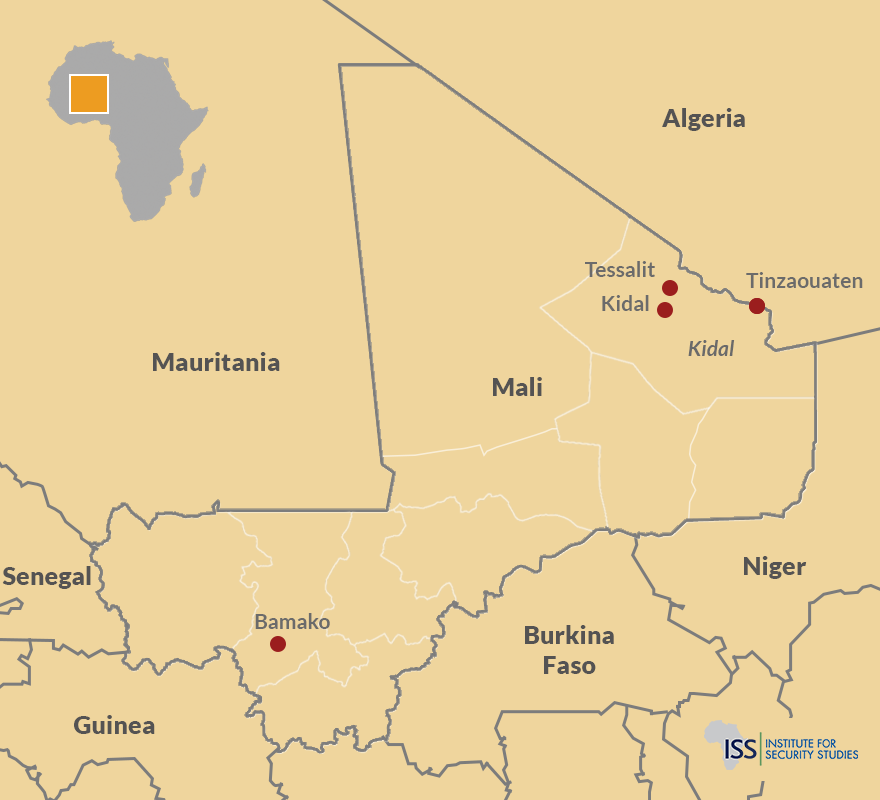
On 4 July, the two groups launched another series of attacks aimed mainly at seizing the strategic town of Anéfis, about 100 km from Kidal. The effort failed, and they currently occupy a relatively small area in the Kidal region that includes the towns of Kidal, Tessalit and Tinzaouatène, where they are based.
The FLA-JNIM coalition against Mali’s government and its Russian Africa Corps allies seems to have redefined the conflict in northern Mali.
Some analysts believe this tactical collaboration is linked to a 2013 directive by Ayman al-Zawahiri, then al-Qaeda’s supreme leader. He called for cooperation with rebel groups to collapse local governments and replace them with emirates as part of the restoration of the caliphate. Other sources told ISS Today that the partnership was simply opportunistic – aimed at forcing the regime to negotiate over the groups’ grievances or to bring it down.
|
Kidal region, Mali
|
Despite some military victories, the coalition remains fragile due to ideological differences and divergent objectives among its components.
The FLA pursues an independent secular state in Azawad, Mali’s vast northern desert region that armed separatist groups claim as their territory, while JNIM fights to establish an Islamic order. Although both oppose the country’s central government, their historical rivalries and disparate visions for communities under their control endure.
The FLA is militarily weakened since withdrawing from Kidal in November 2023. That forced it to ally with the better-armed, more experienced JNIM terrorists to regain control of Kidal and recover Azawad territory. JNIM’s motivations are more about personal and local power dynamics than any military advantage the FLA might offer.
Sources familiar with northern Mali’s political and security dynamics told ISS Today the coalition suited JNIM leader Iyad ag Ghali, who considers himself the natural leader of the Tuaregs in the Kidal region. They suspect Ag Ghali and his cousin Alghabass ag Intalla, an FLA leader, want to weaken the FLA and gradually incorporate it into JNIM. This would strengthen the authority of their Ifoghas tribe in northern Mali.
JNIM’s motivations are more about personal and local power than any military advantage the FLA offers
The sources, who requested anonymity, say this goes against the positions of several FLA and other Tuareg leaders who have long opposed the Ifoghas tribe’s power plays and resisted al-Qaeda’s extremist ideology.
The FLA seems divided on the direction its coalition with JNIM should take. FLA leader Ag Intalla favours merging with JNIM – a move that would benefit from the support of some former drug lords who capitalise on the insecurity, becoming ‘rebel leaders’ to cover up their illegal activities.
By contrast, FLA leader Bilal ag Acherif and his circle limit their ties to JNIM to tactical military coordination, retaining their identity as a politico-military movement fighting for community rights. They worry that allying with a terror group could tarnish their political cause.
These fundamental differences make the alliance uncertain. Some FLA leaders thought they could use JNIM and distance themselves from it once Azawad was conquered. But JNIM is unlikely to let that happen. It would probably use the resulting clashes to expel the FLA, as occurred in 2012 when jihadists turned against Tuareg separatists and forced them from the territory.
If the Malian Armed Forces and their allies manage to stabilise the situation and regain control of the lost towns, particularly Kidal, the FLA-JNIM military alliance could stagnate. The two armed groups’ cohabitation in the confined area around Kidal could revive personal or tribal antagonisms and competition over trafficking routes, potentially leading to a split.
The fragility of the FLA-JNIM alliance doesn’t diminish the seriousness of the threat it poses
The other factor that questions the solidity of the alliance is the position of the Fulani fighters of Katiba Macina, the most active Islamist group in JNIM. These fighters have their own political aspirations, based on the theocratic Fulani empire of Macina, created in 1818 in central Mali, which differs from the FLA’s Azawad independence goals.
The bond between JNIM’s Fulani and Tuareg fighters depends entirely on the personal relationship between Fulani jihadist leader Hamadoun Kouffa and JNIM’s Ag Ghali, but each group’s agenda differs, a senior Tuareg told ISS Today.
The Fulani’s ‘jihad’ aims to defend their territorial and political interests in Mali’s central and southern regions. They do not seem willing to fight for the separatist cause of the Azawadi Tuaregs and Arabs, he says. If ties strengthen between the Tuareg fighters of JNIM and the FLA, Katiba Macina’s Fulani could dissociate themselves from JNIM to focus on their own struggle.
The fragility of the FLA-JNIM alliance does not, however, diminish the seriousness of the threat it poses to Mali’s security. The two groups will continue their battle against the Malian Armed Forces in the northern desert areas, knowing they have more to gain from collaboration than from competition.
But their differing ideologies and objectives may limit the coalition’s sustainability and chances of success.
For permission to re-publish ISS Today articles, please email us. In South Africa, News24 has exclusive rights to republish ISS Today articles. In Nigeria, Premium Times has exclusive rights to republish ISS Today articles.