Cameroon’s contested election sends ripples across fragile border economies
Post-election ‘ghost town’ protests disrupted trade, revealing neighbouring countries’ economic reliance on stability in Cameroon.
When Cameroon’s Constitutional Council announced on 27 October 2025 that 92-year-old President Paul Biya had won an eighth term, simmering tensions in the country boiled over – their effects spilling beyond the country’s borders.
Public frustration was growing ahead of the 12 October polls. Civil society groups and the youth openly doubted whether the political system built around Biya and his ruling party would ever permit a genuine change of power. Yet millions voted, reflecting a hope that elections could make a difference.
But immediately after the Constitutional Council awarded Biya 53.66% of the vote, leading opposition candidate Issa Tchiroma Bakary rejected the outcome, alleging fraud and irregularities. Bakary had earlier claimed victory, publishing polling station data on social media to support his 54.8% tally.
Protests and clashes with security forces across major cities claimed 16 lives, government officials said. Independent observers and humanitarian sources cited between 30 and 48 killed and over 800 arrests.
Bakary’s call for a national ‘ghost town’ protest from 3-5 November in response to the crackdown resonated widely across the country with immediate domestic consequences. Daily wage earners lost income, transport disruptions isolated neighbourhoods, and basic goods rose in price. But the regional consequences were even more significant.
|
Cameroon and affected neighbouring countries
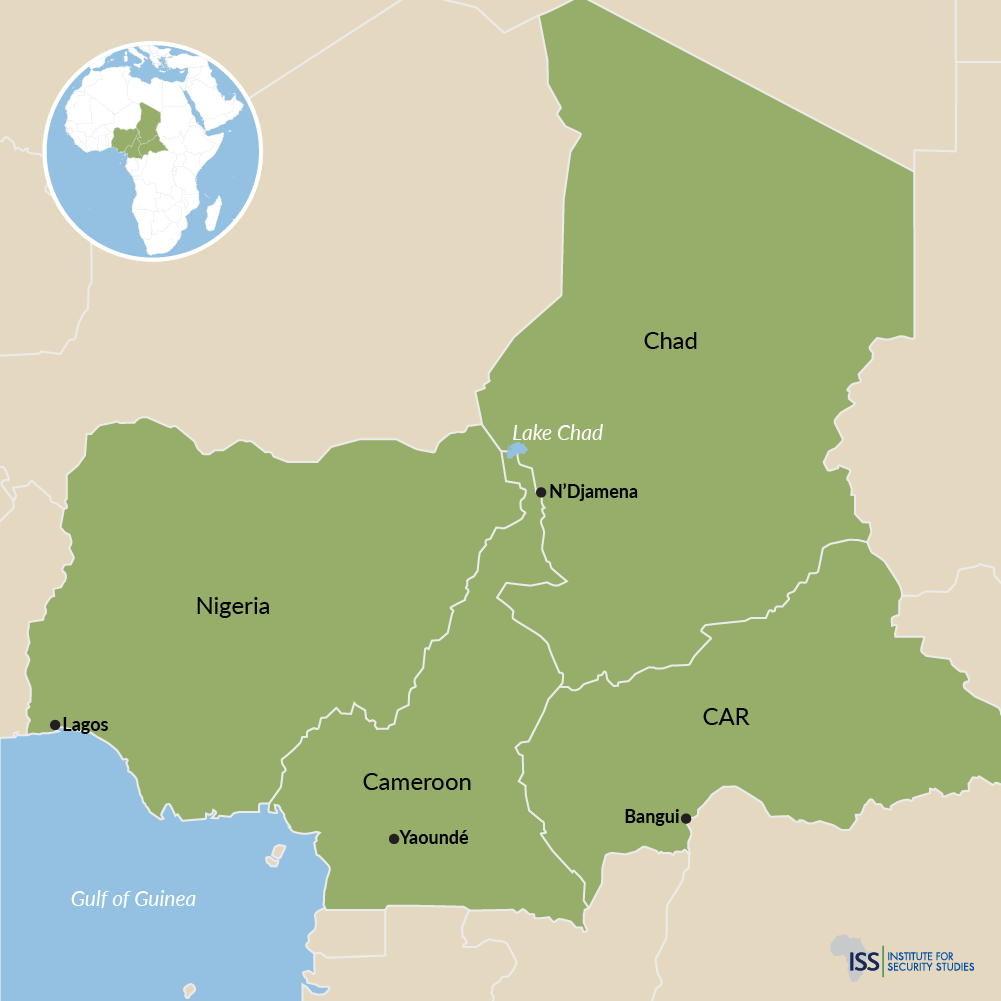
|
The ghost town slowed economic activity at Douala’s port, Cameroon’s economic and logistics hub and the entry point for trade into CAR and Chad. Port operators reported delays in the handling and distribution of goods. One business estimated daily losses in Douala of over 10 billion FCFA (around US$18 million). Further losses were incurred by the withdrawal of foreign investors pending the restoration of full political stability.
The Central African Republic (CAR) was immediately and severely affected. Over 80% of the CAR’s imports move through the Douala-Bangui corridor, which runs from Douala on Cameroon’s coast through the centre of the country and into the CAR. World Bank and United Nations (UN) logistics agencies have repeatedly underscored Bangui’s dependence on this single coastal route for fuel, medicines, foodstuffs and humanitarian supplies.
As trucks remained stalled along the route, transport delays rippled into Bangui’s markets: cooking oil, rice and flour prices skyrocketed, and traders reported supplies running thin in days. Families described cutting back, diluting meals and replacing oil with water.
For a country battling chronic insecurity and weak domestic production, even a brief disruption in Cameroon heightened hardship. This shows how precarious the CAR’s dependence on Douala has become, and how political instability in Cameroon can deepen cross-border fragility.
For Chad, even short delays translate into higher retail prices and supply shortages, particularly in N’Djamena
Landlocked Chad is similarly exposed, with the Douala-N’Djamena corridor being its principal commercial artery, handling most of its imports. This is due to movement restrictions imposed by Boko Haram since 2013 on the Gamboru-Fotokol-Kousseri-N’djamena corridor, which runs from north-east Nigeria through northern Cameroon into Chad.
The three-day shutdown paralysed sections of Douala’s trucking and warehousing operations. Business associations in Cameroon warned that the ghost town order risked disrupting already fragile supply chains. Logistics operators were concerned about the backlog, as trucks, shops, and warehouses remained shut for three days.
For Chad, even short delays translate into higher retail prices and supply shortages, particularly in N’Djamena and border communities. These pressures compound existing vulnerabilities, including displacement linked to Sudan’s crisis and insecurity in the Lake Chad Basin. When formal logistics slow, traders often resort to informal routes – a shift that exposes supply chains to armed groups and increases smuggling and illicit taxation risks.
Webs of trade routes, agricultural markets and transit communities underpin livelihoods in border regions
The northern Cameroon-Nigeria border is a dense web of trade routes, agricultural markets and transit communities that underpin livelihoods on both sides. During the ghost town protest, traders from Maroua, Far North Cameroon’s capital city, said their goods were ‘starting to rot’ as markets shut down, with nationwide transport slowdowns.
The shutdown also affected the Mubi-Guider-Garoua corridor – the only secure route linking northeast Nigeria to Cameroon’s North and Far North. The corridor is also a key channel for the movement of cereals, livestock, fuel and motorcycle traffic between the two countries. Repeated Boko Haram attacks have disrupted alternate routes, forcing trade onto the Mubi-Guider-Garoua axis. The ghost town protest slowed traffic and compounded market access restrictions along this route.
During the shutdown, Bakary’s hometown Garoua – capital of Cameroon’s North Region –and nearby towns noted a slowing of local commerce and reduced cross-border movement that Nigerian and Cameroonian traders depend on. In a region where insecurity already constrains mobility, even a short interruption on the Cameroonian side can unsettle markets in neighbouring Nigerian towns such as Yola and Mubi.
Elections in corridor states can affect trade, livelihoods, humanitarian assistance and border stability
Institute for Security Studies research on Nigeria-Cameroon border dynamics highlights this risk: internal shocks in one state distort cross-border commerce, complicate surveillance and weaken joint operational planning. In a region where communities depend on predictable flows of goods and security forces rely on mutual support, a political crisis on one side of the border becomes a shared vulnerability.
All these events show that Cameroon’s political stability is a regional public good. The country is not merely a national economy; it is a transit backbone for parts of Central and West Africa, especially areas whose logistical diversification fuels their dependence on transit corridors.
Elections in such corridor states are not isolated national events – they are transnational moments with implications for trade, livelihoods, humanitarian assistance and border stability. The Cameroonian crisis was a trigger and amplifier of pre-existing regional fragilities.
Tensions in the country seem to have cooled, yet the crisis is far from resolved. Bakary’s decision to take refuge in Nigeria and Cameroon’s determination to pursue him as a ‘dangerous criminal’ keeps the political temperature high and extends the post-election deadlock.
Any attempt to arrest or attack Bakary could reignite tensions in Cameroon. Given how quickly the post-election unrest spilt across its borders, another flare-up wouldn’t be confined to Yaoundé or Douala. For a region already navigating conflict, displacement and economic stress, the potential implications are dire.
Exclusive rights to re-publish ISS Today articles have been given to Daily Maverick in South Africa and Premium Times in Nigeria. For media based outside South Africa and Nigeria that want to re-publish articles, or for queries about our re-publishing policy, email us.