Blue justice will be the real test of the Chagos deal
Politicking in the US and UK distracts from Chagossians’ need to determine their resettlement and role in blue economy governance.
Published on 09 February 2026 in
ISS Today
By
The 2025 United Kingdom (UK)-Mauritius agreement over the Chagos Archipelago was a victory for international law and post-colonial justice. But how the deal is implemented will be the real test of whether justice is served.
Mauritius had long held that Britain’s 1965 removal of the islands from Mauritius while it was a colony was unlawful, and violated the decolonisation process. The same applied to the forced relocation of Chagossians to make way for the United States (US) military base on Diego Garcia, the largest island in the archipelago.
Most debate now centres on how the transfer of sovereignty will affect US and UK operations of the strategically significant military base. The treaty enables the UK to retain legal control over Diego Garcia while allowing its operations to continue. In return, Mauritius will receive an estimated £100 million a year.
|
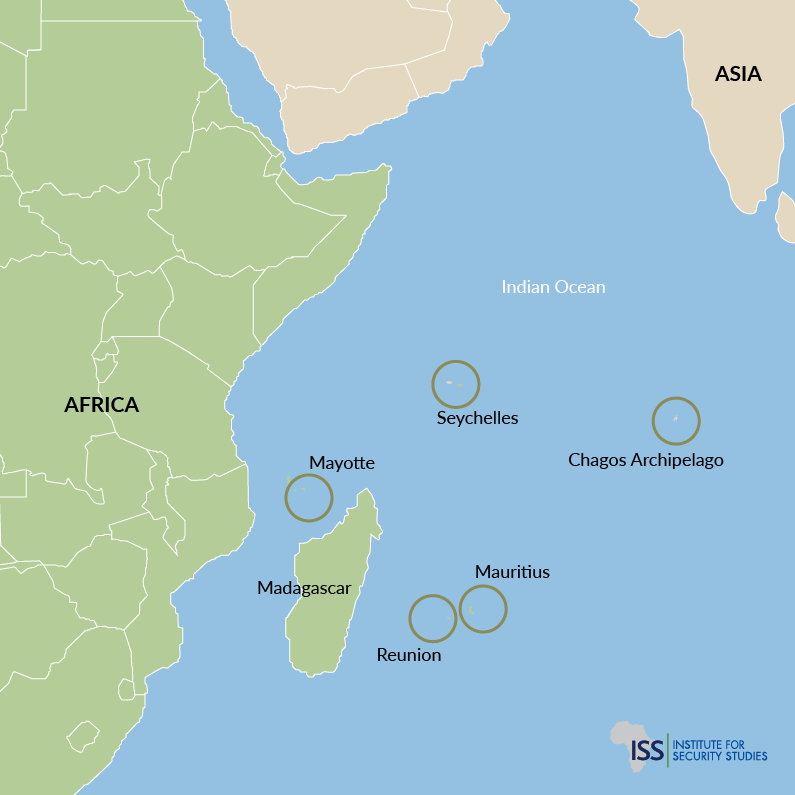
Chagos Archipelago
|
The archipelago’s exceptional geostrategic position heightens the stakes. Diego Garcia sits at the centre of the Indian Ocean, giving forces access to East Africa, the Persian Gulf and Arabian Sea, as well as South and Southeast Asia. For decades it has served as a forward logistics and strike hub for US and UK forces, supporting Afghanistan and Iraq and anti-Islamic State operations.
From this location, the US and allies help secure some of the world’s most critical maritime chokepoints. These are the Strait of Hormuz in the Middle East, Bab al-Mandab between Yemen and the Horn of Africa, and the sea lanes linking to the Strait of Malacca between Indonesia and Malaysia. As global powers compete, this kind of control carries influence far beyond the islands themselves.
Interest in the Chagos matter has recently intensified as ratification of the agreement becomes entangled in UK politics. Critics frame the transfer as ‘giving away’ strategic territory, even though the military base remains intact. US President Donald Trump’s social media post fuelled the debate: ‘The UK giving away extremely important land is an act of GREAT STUPIDITY.’
More concerning is that the agreement says little about Chagossians themselves. They have no guaranteed resettlement timetable, funding commitments or formal roles in governing their islands. For them, the biggest question is whether Mauritius will implement the treaty in a way that delivers justice, dignity and viable futures for Chagossians wishing to return (barring to Diego Garcia) after decades of impoverishment and neglect.
Will Mauritius implement the treaty in a way that delivers justice, dignity and viable futures for Chagossians?
Mauritius will need to visibly exercise sovereignty over Chagos by actively patrolling and protecting the recovered territory. The most practical route is through blue economy governance – the sustainable use of ocean and aquatic resources for economic growth while preserving ecosystems. As one of Africa’s earliest and most consistent adopters of the blue economy, Mauritius is well placed for this role.
Another task is to declare the islands a Marine Protected Area (MPA). Mauritius has already committed to declaring a ‘large-scale multi-purpose’ MPA that supports both conservation and resettlement.
But with a vast Exclusive Economic Zone, limited patrol assets and heavy reliance on partners, Mauritius’ ability to carry out enforcement at sea is already stretched. Incorporating the remote Chagos Archipelago will expand these demands. Without external support and community participation, surveillance could weaken, creating opportunities for illegal fishing and trafficking.
Mauritius faces three choices. First, retain the UK’s current strict exclusionary conservation model, which protects biodiversity but risks reproducing the very dispossession the treaty allows it to correct. Second, dilute these protections to enable rapid economic use, which signals control but weakens conservation and invites illegal fishing.
Or third, uphold blue justice. This means any plan to support resettlement must make local communities key role players and stakeholders in conservation and protection.
Blue justice makes local communities key role players and stakeholders in conservation and protection
In practice, blue justice reduces governance gaps through five measures: legally guaranteed resettlement rights; co-management of small-scale and sustainable fisheries and community monitoring and patrols; funding for island infrastructure; formal representation of Chagossians in decision-making bodies; and fair access to employment in Chagos and Mauritius.
Fisheries crime will likely present an ongoing test. Without credible enforcement, conservation collapses taking livelihoods with it, making external support indispensable. Industrial distant-water fleets and vessels from nearby states already operate intensively across the Indian Ocean. Some work illegally in Chagos waters, disabling tracking systems, under-reporting catches, or transhipping at sea to evade controls. Conservation credibility will depend on patrolling and surveillance, with Chagossian participation.
Another challenge is that the treaty offers no guaranteed resettlement path. Article 6 merely provides that Mauritius ‘is free [not obliged] to implement a programme of resettlement.’ Some Chagossians want assurances that Mauritius will deliver on their behalf. A 2025 UK House of Lords survey shows that many feel Mauritius has marginalised them since their relocation.
Resettlement is likely to be costly and technically tricky due to the islands’ remoteness and lack of infrastructure. Investment in housing, education, and health services will be required. Without a viable economic base, any return would quickly falter. Resettlement must be tied to a credible blue economy strategy rather than treated as a purely humanitarian gesture.
Resettlement must be tied to a blue economy strategy rather than treated as a purely humanitarian gesture
The agreement commits the UK to several financial obligations. In addition to paying Mauritius the annual £100 million for leasing Diego Garcia, it must establish and contribute £40 million to a trust fund for Chagossians, and provide an annual development grant of around £45 million to Mauritius for suitable projects, including strengthening the blue economy.
But how much of these funds will reach Chagos itself? And will they be allocated using a blue-justice-first approach, and have guarantees that enable Chagossians to rebuild secure and dignified lives?
A voluntary, well-funded resettlement pathway is needed that: enables real representation in local decision making; supports sustainable employment in blue education, conservation and small-scale, community-led tourism; provides fair access to employment opportunities; and protects marine areas.
These enforcement and governance gaps are not abstract institutional problems. They will directly shape whether any Chagossian return is viable. Blue justice in the archipelago is not optional; it must be the anchoring principle.
Exclusive rights to re-publish ISS Today articles have been given to Daily Maverick in South Africa and Premium Times in Nigeria. For media based outside South Africa and Nigeria that want to re-publish articles, or for queries about our re-publishing policy, email us.