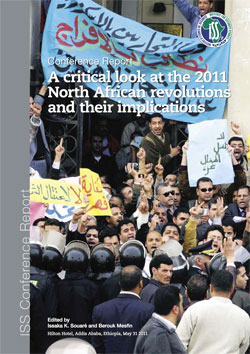
A critical look at the 2011 North African revolutions and their implications
 The African Conflict Prevention System (ACPS) of the Institute for Security Studies (ISS) and the broader ISS family strive to complement and support the work of African institutions, particularly the African Union (AU), on issues of peace and security on the continent. The ISS is a Pan-African policy research institution and thinktank focusing on human security issues in Africa. The institute’s research activities and engagements are both practical and policy orientated, and its mission is to conceptualise, inform and enhance the debate on human security in Africa in order to support policy formulation and decision making at various levels.
The overarching objective of this conference was toassist a variety of African policy and decision makers and other stakeholders to formulate informed policies for an effective management of the crises in NorthAfrica at these interesting but extraordinary times forthe continent. As ISS Executive Director Jakkie Cilliers has written in a 2010 monograph on African Futures 2050:
[T]hese are extraordinary times in Africa and indeed in the global landscape. Africa is witnessing amazing developments with events in Tunisia, Egypt, and Libya with re-vibrating social and political consequences and unrest in Algeria, Morocco, and Djibouti with [the potential to] spread in various forms to other parts of the continent. The world and indeed Africa is changing before our own eyes in a complex world of shifting alliances, networks and increasing roles for the CSOs, research institutions and the social media to shape the future in these countries.
Specifically, the conference aimed to discuss and generate policy responses to peace and security challenges
in North Africa and thereby contribute to continuing efforts for sustained democratisation and human security in the region and elsewhere in the continent. It brought together experts on North Africa, both from the region and from within the ISS, as well as representatives from the AU, European Union (EU) and the League of Arab States (LAS). In addition to the speakers, the conference recorded the participation of more than 100 scholars, diplomats, practitioners and students, including some that had travelled from as far as Mozambique specifically to attend the conference.
The present report contains the papers presented at the conference as well as one paper whose author was not able to present it at the conference due to other commitments. The main rationale behind this report is to ensure a wider and durable reach of the insights and analyses presented during the conference and for these insights to go beyond those that attended the conference. While some elements contained in the report may have been overtaken by events in the period between the date of the conference on 31 May 2011 and the publication of this report, I believe that the analyses and expert insights contained in it still remain pertinent
in shaping our understanding of both past and present events, and even some future ones. In conclusion, I would like to express my sincere appreciation to all the participants at the conference and our various donors and stakeholders that made it possible.
Edited by: Issaka K. Souaré and Berouk Mesfin
This publication was made possible through core funding provided to the ISSby the governments of Denmark, the Netherlands, Norway and Sweden