Will monitoring of eastern DRC’s ‘ceasefire’ improve compliance?
The first deployment of the monitoring mechanism is positive, but current conflict conditions should temper expectations.
Published on 10 September 2026 in
ISS Today
By
Bram Verelst
Senior Researcher, Conflict Prevention, Management and Peacebuilding in the Great Lakes Region, ISS
Nicodemus Minde
Researcher and adjunct faculty member at United States International University – Africa, Nairobi
The first mission to verify the eastern Democratic Republic of the Congo (DRC) ceasefire agreed in November 2025 began its work in South Kivu on 24 August. But can facts be established in a fragmented and polarised context? And can the mission’s findings change how warring parties assess the costs, risks and benefits of continued fighting?
The Expanded Joint Verification Mechanism Plus (EJVM+) was activated following August talks in Switzerland between the DRC government and Alliance Fleuve Congo (AFC)/M23. Qatar, the United States (US) and African Union (AU) helped mediate.
Established through the Doha negotiations between the DRC and AFC/M23, the EJVM+ reports to the Ceasefire Oversight and Verification Mechanism, which supervises implementation and aims to create conditions for de-escalation and dialogue.
Kickstarting the EJVM+ is one of the most tangible signs of progress under the Doha framework, providing a way to verify alleged ceasefire violations by the DRC government and AFC/M23.
However current conflict conditions should temper expectations. Both the government and AFC/M23 continue to contest territory through drone strikes, recruitment and alliances with other armed groups. Belligerents often use ceasefires to reposition or rearm forces, establish new ‘facts’ on the ground and consolidate territorial control.
The ceasefire also fails to separate forces and reduce the risk of renewed fighting, which could have been done by providing clear ceasefire lines, force withdrawals, cantonments and buffer zones.
|
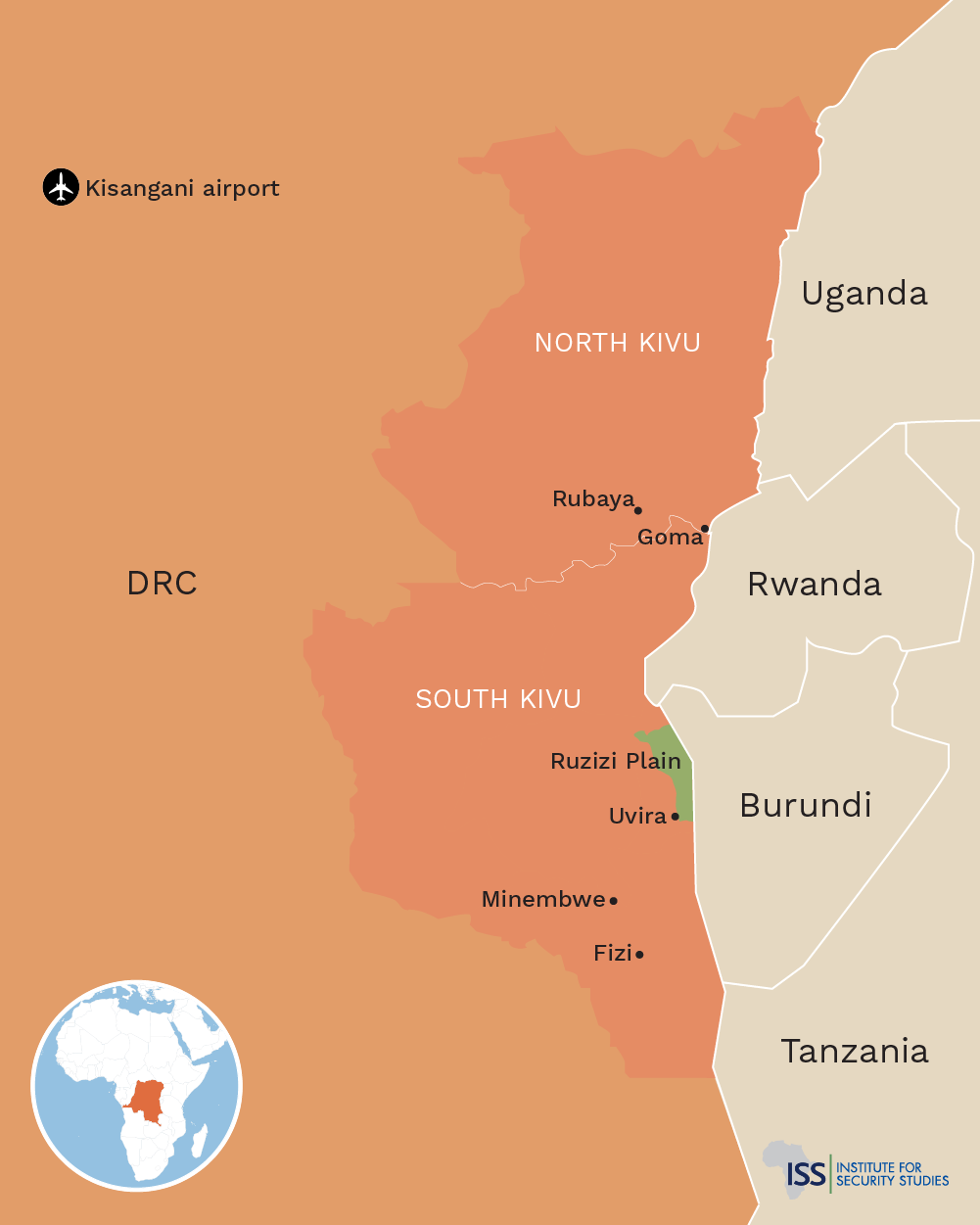
Conflict and monitoring sites, eastern DRC
|
Choosing South Kivu’s Minembwe for EJVM+’s first verification mission is significant as the area embodies many of the complexities that make ceasefire monitoring in eastern DRC difficult.
First is worsening violence. Following M23’s withdrawal from Uvira, the DRC government launched an offensive towards Minembwe in early 2026, trapping citizens, restricting humanitarian access and the movement of goods. In early July, rebels consolidated control in the highlands, where fighting continues.
Second, the conflict does not involve only the government and AFC/M23. In Minembwe, the armed movement of the Banyamulenge – a Congolese Tutsi community whose citizenship and security have been contested – has aligned with AFC/M23, while the Congolese army collaborates with fragmented Wazalendo groups.
Heightened tensions between Burundi and Rwanda also make ceasefire monitoring difficult. With Burundian troops deployed to back Kinshasa, and Rwanda supporting AFC/M23, the war risks escalating longstanding rivalries and fuelling proxy conflicts, including through increased Rwandan support for Burundian armed groups.
The DRC and AFC/M23 continue to launch drone strikes, recruit fighters and ally with local armed groups
A central EJVM+ weakness is that its scope is limited to a two-party ceasefire in a conflict involving regional actors and multiple armed groups that rarely consider themselves bound by such a ceasefire.
Fragmentation of diplomatic efforts is another complicating factor. Alongside the Doha process, the US is mediating between the DRC government and Rwanda. As the implementation of that peace agreement stalls, Rwanda’s military involvement in eastern DRC, along with the Forces Démocratiques de Libération du Rwanda (FDLR), has continued.
Developments arising from these parallel tracks are beyond the EJVM+’s remit. Rebel withdrawals from Uvira and the Ruzizi Plain in January and May resulted from US diplomatic pressure rather than the Doha negotiations and lacked neutral verification.
Although it has been suggested that the EJVM+ mandate be extended to the Washington Accords, the ceasefire excludes the withdrawal of Rwandan forces and the disarmament of the FDLR. That means the EJVM+ cannot verify those commitments and lacks direct links to the mechanisms overseeing the DRC-Rwanda agreement.
This reflects a broader problem: fragmented peace initiatives have produced overlapping monitoring and verification mandates tied to partial ceasefire arrangements lacking clear political objectives.
The EJVM+ covers only a two-party ceasefire in a conflict involving regional actors and many armed groups
The EJVM+ also faces operational constraints. Investigating violations across an extensive and difficult conflict zone strains its limited funding, personnel and logistics. The downsizing of the United Nations Organisation Stabilisation Mission in the DRC (MONUSCO) compounds the problem. Since its 2024 withdrawal from South Kivu, MONUSCO has no civilian protection mandate or capacity to respond to human rights abuses there.
Another challenge for EJVM+ is the specialised expertise needed to investigate drone strikes that can reach beyond front lines. Recent attacks have been attributed to both AFC/M23 and the DRC army. Sophisticated equipment capable of causing GPS interference further complicates monitoring and verification.
Access is another constraint. AFC/M23’s parallel administration and the many armed groups in North and South Kivu could limit EJVM+’s movement. An overreliance on armed groups’ consent could undermine its neutrality and deter people from engaging with the mechanism freely. This is particularly concerning because the ceasefire arrangement does not explicitly cover violence against civilians.
Still, the EJVM+ remains unique. It is the only recognised ceasefire mechanism and is supported by the International Conference on the Great Lakes Region (ICGLR) and MONUSCO. It can help establish facts, reduce competing narratives and build confidence in the Doha process.
Verified violations must generate political follow-up, sustained external engagement and accountability
But the EJVM+ needs financial support and specialised training to investigate and document violations. In the longer term, sustainable funding from ICGLR member states can reduce the mechanisms’ dependence on external support and maintain regional ownership. To protect EJVM+’s neutrality, external actors supporting the peace process, including Qatar, the US, AU, ICGLR and UN, must counterbalance the mechanism’s reliance on warring parties’ consent.
Strong guarantees of freedom of movement and security are needed for MONUSCO and EJVM+ personnel. Clear procedures are also required when third-party actors supporting the ceasefire want to initiate a verification mission. Steps to address non-compliance are also vital. Verified violations must generate political follow-up, sustained external engagement and accountability that can influence the actions of the DRC government and AFC/M23.
The EJVM+ would also benefit from a more robust ceasefire arrangement that accounts for actors outside the Doha process, and has provisions for humanitarian access and peacekeeping.
Ultimately, eastern DRC needs a peace process that incentivises honouring a ceasefire, not just a record of who broke it.
For permission to re-publish ISS Today articles, please email us. In South Africa, News24 has exclusive rights to republish ISS Today articles. In Nigeria, Premium Times has exclusive rights to republish ISS Today articles.