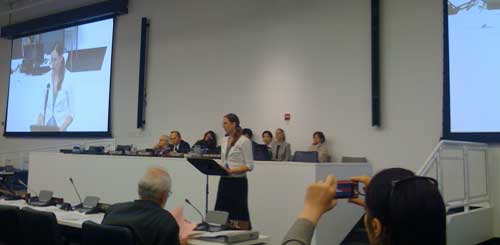
Statement by Amelia Brooryk at the Nuclear Non-Proliferation Treaty (NPT) Review Confe
Statement by Ms Amelia Broodryk on behalf of the Group of non-governmental
experts from countries belonging to the New Agenda Coalition
Nuclear Non-Proliferation Treaty (NPT) Review Conference
United Nations, New York
7 May 2010
Good Afternoon,
I am
speaking on behalf of a grouping of individuals from civic organizations in
countries belonging to the New Agenda Coalition (NAC) including the Egyptian
Council for Foreign Affairs, Pax Christi Ireland, the
Mexican Council on Foreign Relations, the New Zealand-based Peace Foundation
Disarmament and Security Centre, the Institute for Security Studies in South
Africa and the Stockholm
International Peace Research Institute. This group was established in
2007 to support the efforts
of NAC particularly during the 2010 NPT Review cycle. While we would like to
take this opportunity to convey our support for the views expressed in Working
Paper 8, submitted to this Conference by Egypt on behalf of the seven members
of NAC, it is important to note that, as members of civil society, we may have
slightly different views and opinions.
My
presentation summarizes the key elements of a longer statement drafted by the
Group, which has been circulated.
As stated by numerous speakers, the
2010 Review Conference is taking place at a very propitious time. There
is a very real expectation that this Conference presents a unique opportunity
for progress towards restoring confidence in the Treaty on the Nonproliferation
of Nuclear Weapons (NPT) and in accelerating the achievement of a world free of nuclear weapons. There is
also a strong belief that the outcome of this Review Cycle will have a
significant impact on both international peace and security and the NPT itself.
In the last few days, we have
been urged to re-define how we should assess whether this Conference is a
success or not. While we need to be realistic and practical, we should not be
content to lower our expectations to such an extent that we do not come out
with a clear forward-looking program of action.
In addressing all three pillars
of the Treaty, this Grouping will consider that the Review Conference has
achieved a measure of success if:
1. There
is concrete agreement on ways to implement the 1995 Resolution on the Middle
East, including the hosting of a regional conference. We
expect the Review Conference to endorse such an initiative and recommend convening such a
conference within a year.
2. NPT States Parties undertake to increase
their efforts to
systematically engage with India, Pakistan, Israel and the Democratic Peoples’
Republic of Korea to join or (rejoin)
the NPT as NNWS.
3. The outcomes of the 1995 and 2000 Review
Conferences are re-affirmed together with arrangements for their implementation.
4. A preparatory process is established to explore the legal,
technical, institutional and political measures required to achieve and
maintain a nuclear-weapons-free world.
5. The
Nuclear Weapon States uphold the International Court of Justice’s Advisory Opinion on the
Legality of the Threat or Use of Nuclear Weapons of 1996 and move quickly to eliminate all nuclear weapons.
6. States
Parties to the NPT recognize that future discussions of the
internationalization of the nuclear fuel cycle should involve all stakeholders,
with the IAEA playing a key role in order to ensure the creation of a
non-discriminatory global model for the supply of nuclear fuel.
7. A follow up mechanism between this Review
Conference and the next is created to oversee the state of implementation of
the outcomes. The outgoing President and his bureau could constitute the core
of such a mechanism.
When I was younger,
I remember my father saying that he doubted whether he would see the end of
Apartheid in his lifetime. This year, on April 27, he celebrated 16
years of living in a non-racial democracy. In a similar vein, a
Nuclear-Weapon-Free World – in our lifetime – is indeed possible.
Thank you.