Europe’s heatwave warning for Africa: fast-track a climate leapfrog
A looming super El Niño makes Africa’s leap from fossil fuels to a renewables-dominated energy mix urgent.
Published on 07 September 2026 in
ISS Today
By
Dhesigen Naidoo
Research Associate, Climate Risk and Human Security Project, ISS Pretoria
The heatwave that swept Europe this summer claimed at least 35 000 lives. Other parts of the world were also affected, with heatwaves in India, wildfires in Indonesia and a glacial melt-related flood disaster in Nepal, all of which left a path of devastation.
These extreme weather events preceded the forecasted ‘super El Niño’ poised to hit during the Southern Hemisphere summer, with grave consequences for the already vulnerable global south, especially Africa.
The Northern Hemisphere summer has been devastating. July 2026 was the hottest month ever recorded, tied with July 2024, while the highest sea surface temperatures were logged last month. This means an extensive amount of energy in the atmosphere, a driver for extreme weather events.
In addition to the heatwave’s health effects, the impact on the economy has been significant, with new challenges for Europe’s energy security. Both water scarcity and much higher water temperatures led nuclear plants to cut back on electricity production. Drastic measures in France and Switzerland saw nuclear plants going offline, while Romania, Hungary and Bulgaria had to shut down or reduce generation.
GDP losses due to the heatwave are forecast at €180 billion – larger than the EU’s forecasted growth rate
The upside is that Europe has significant solar capacity and could offset the shortfall from reduced nuclear production and increased demand for air conditioning and fans. Solar output went up by 17% on June and July heatwave days.
Accurate calculations of how reduced energy availability affected production, manufacturing and services are yet to come, but initial estimates are staggering. The Dutch Triodos Bank forecasts that the 2026 heatwave would cause the European Union to shed 1% of its gross domestic product (GDP), amounting to almost €180 billion – larger than its International Monetary Fund forecasted growth rate of 0.9%.
The agricultural sector has been hardest hit, with 3%-7% overall losses in output. The numbers for individual crop types and animal products in many European countries are much higher.
The repetition of heatwaves and droughts year after year leaves little or no room for recovery. The weather forecasting platform WFY24 predicts continued high temperatures for September, and an intense September/October flash-flood season along the Mediterranean.
Europe’s inability to avert the devastation is frightening for Africa, which has much less resources
The lessons for Africa are stark. The Northern Hemisphere’s hottest July on record, combined with the predicted strong El Niño event, is setting up the 2026/27 Southern Hemisphere summer as potentially one of the worst on record.
Europe’s inability to avert the devastating impact – with its much higher levels of infrastructure, capacity and finance – is frightening for much of Africa, which has little of these resources. Could that 1% drop in Europe’s GDP become much higher for Africa?
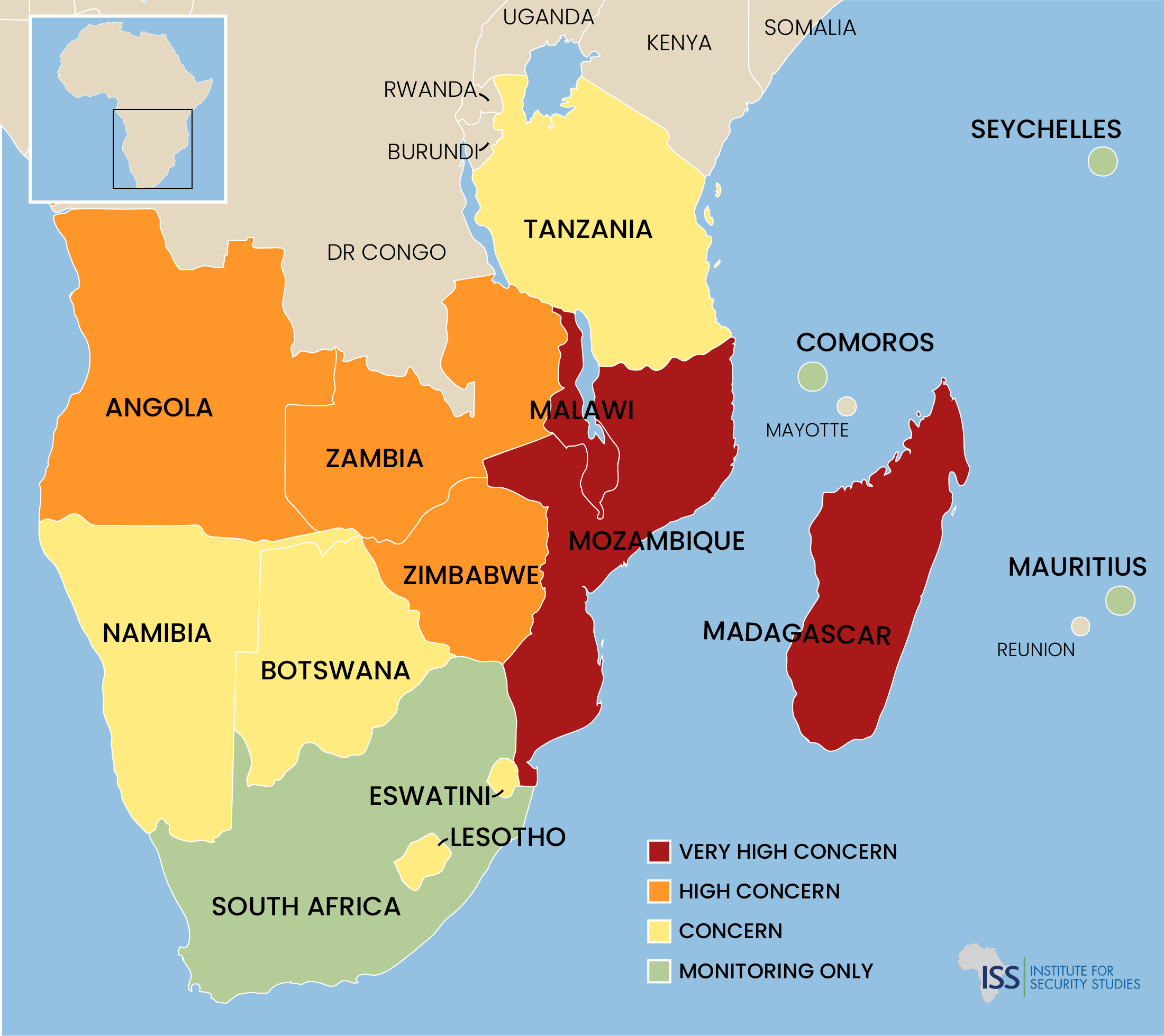
The continent has been responding. The African Union Commission convened the 21st African Continental Climate Outlook Forum in July to ensure that weather and climate scientists are abreast of the latest developments. The Southern Africa 2026 El Niño Preparedness Alert, compiled by the United Nations (UN) Office for the Coordination of Humanitarian Affairs and partners, identifies four categories of countries in the sub-region with respect to preparedness (see map).
|
Four categories of El Niño Preparedness, Southern Africa
|
South Africa has taken lessons from the previous high-impact El Niño, which introduced a multi-year rolling drought and generated a Day Zero water scare in Cape Town. The bumper maize harvest and improved agricultural water reserves provide a buffer heading into El Niño, but a poor 2026/27 crop will lead to further food price inflation and reduced affordability.
Government and stakeholders recognise the potential crisis and have called for a ‘war room’ to be set up. Specific funding is being set aside, like the R12 million (US$751,458) allocation for the anticipated Western Cape fire season.
All these efforts are laudable, but the means available for Africa to take action are limited. Donor support is dwindling and infrastructure is poor. The funds available will barely cover disaster management costs, let alone measures to build resilience. Europe’s repeated heatwaves have not sparked higher investments in Africa’s climate resilience and disaster reduction.
Current weather and climate changes are not incremental and slow. We are in the midst of a stepwise climatic change. That +1.5°C threshold above pre-industrial levels – set by the UN Paris Agreement as a critical warming limit – will be the new norm in the next decade, even with earlier achievement of peak emissions and Net Zero.
Africa must consider foregoing a fossil fuel-heavy development phase in favour of a low-carbon trajectory
The 2026 European heatwave and its Southern Hemisphere equivalent in the next three months will remind us of this reality. We may have to live through another unbearably hot and dry summer, as we contemplate an even hotter future.
The need to engage with the concept of a climate leapfrog – foregoing an intermediate fossil fuel-heavy development phase and adopting a low-carbon rapid development trajectory, with renewables dominating – is now more urgent than ever.
The leapfrog will have to include two new dimensions. The first is the development of disaster management infrastructure and capacity as extreme weather events become both more frequent and intense. The second is to accelerate the growth of an African climate adaptation industry.
The UN Environment Programme’s seventh Global Environment Outlook (GEO-7) provides a realistic yet frightening view of the world in 2050, assuming no major changes in the fossil fuel-addicted global economy. Higher land and sea-surface temperatures will mean more intense storm events, more frequent droughts, biodiversity loss, agricultural declines and mass human migration as parts of the world become unlivable.
This world seems more probable as right-wing politics shift government decision making further away from climate action in much of the global north. Southern leadership is needed. Making the African El Niño 2026 story different to that of Europe’s latest heatwave would be an encouraging start.
For permission to re-publish ISS Today articles, please email us. In South Africa, News24 has exclusive rights to republish ISS Today articles. In Nigeria, Premium Times has exclusive rights to republish ISS Today articles.