Boko Haram’s Cameroonian commanders are extending the group’s reach
Boko Haram’s growing reliance on its Cameroonian leaders is fuelling attacks in the country and strengthening the group’s resilience.
Published on 03 August 2026 in
ISS Today
By
Célestin Delanga
Research Officer, West Africa, the Sahel, the Lake Chad Basin and Central Africa, ISS
Boko Haram is appointing an increasing number of Cameroonian fighters to senior positions, Institute for Security Studies (ISS) research shows. These commanders play an active part in the group’s resilience by providing it with access to local resources and information on targets for attacks and extortion.
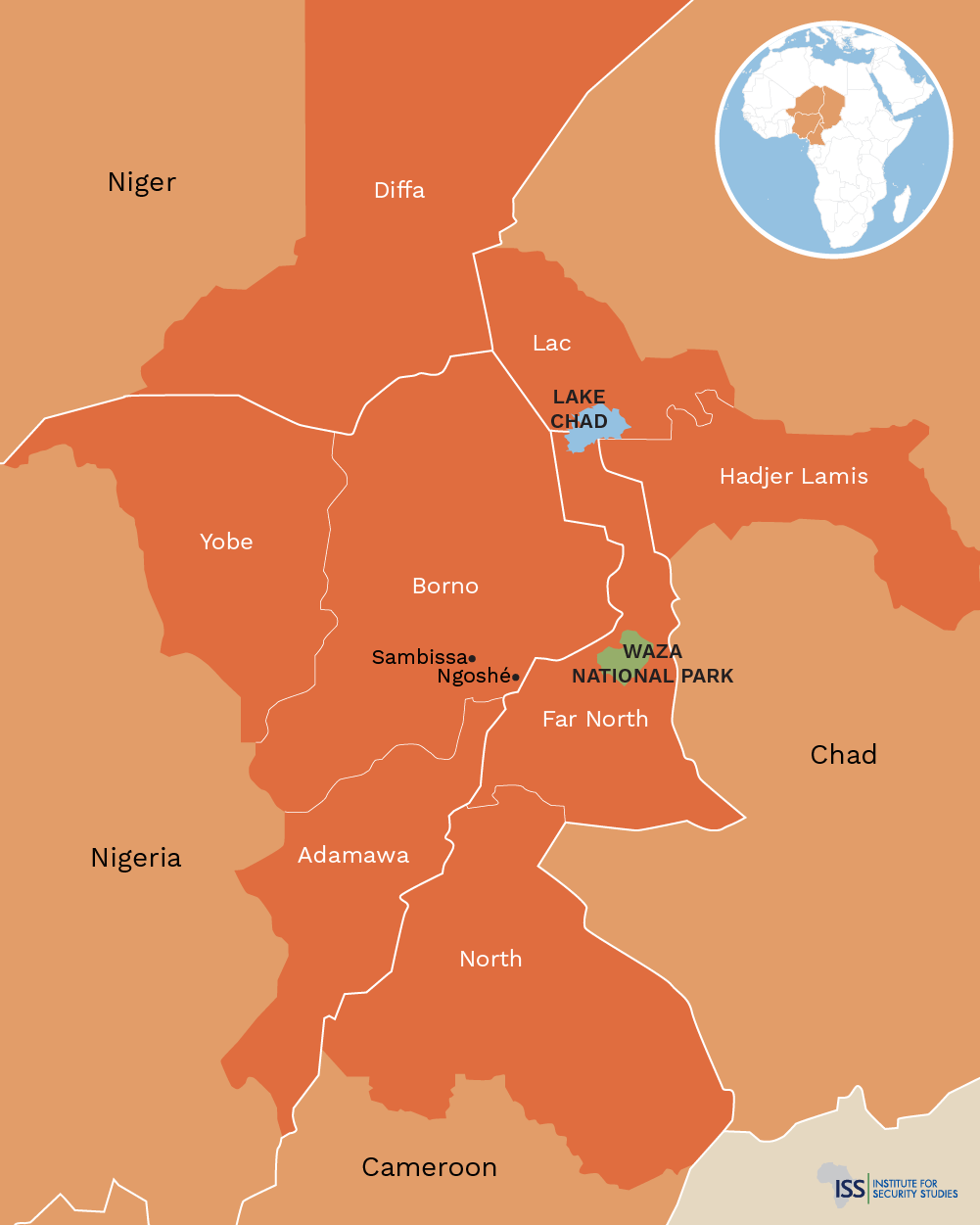
The trend follows a shift in the location of attacks by the extremist group’s two factions – Islamic State West Africa Province (ISWAP) and Jama’tu Ahlis Sunna Lidda’awati wal-Jihad (JAS). According to ACLED, in 2025 the highest number of incidents occurred in Cameroon’s Far North region compared to the seven other Lake Chad Basin regions affected: Nigeria’s Borno, Adamawa and Yobe states; Lac and Hadjer Lamis provinces in Chad; Cameroon’s North region; and Diffa in Niger.
The high level of attacks in Far North stems from ISWAP’s strategy of territorial expansion. Fighters of Cameroonian origin are given a share of power to enable the targeting of people and property in Cameroonian territory.
|
Eight regions in Lake Chad Basin most affected by Boko Haram attacks
|
These leaders are able to influence internal decision making and ground operations in Cameroon. With their first-hand knowledge of the local context, they can plan and coordinate attacks on their home ground, recruit fighters and ensure logistical support from Cameroon.
ISS research shows that under these leaders, 714 reported Boko Haram attacks were carried out in 2025, and 227 between January and June 2026.
Cameroon’s border regions are of major interest to both ISWAP and JAS. Cornered in Nigeria by the army’s ongoing military offensives including air strikes, the armed groups find refuge in remote areas along the border between Nigeria and Cameroon.
They plunder nearby Cameroonian communities and launder funds derived from terror activities. Livestock stolen in Nigeria, for example, is generally sold off in Cameroon’s border markets. Busy cross-border trade gives ISWAP and JAS easy access to essential supplies like food, clothing, medicines and fuel. The more areas they can access to obtain resources, the more resilient they become, with local fighters used as scouts.
In 2025, Cameroon’s Far North had more terrorist incidents than the seven other Lake Chad Basin regions
Cameroonian leaders now play key roles in Boko Haram’s activities. At the strategic level, a special adviser responsible for Cameroon sits alongside Ali Ngulde, JAS’ second-in-command. At the tactical level, there are at least five Cameroonian qaids (commanders) between Ngoshé and Sambisa in Nigeria, responsible for mobilising around 1 000 fighters on the ground in Mayo-Sava and Mayo-Tsanaga in Cameroon’s Far North.
Qaids lead around 400 fighters. Their strengths include a command of local languages and a thorough knowledge of the area, allowing almost daily operations by Boko Haram. These commanders select lower-ranking fighters from their own areas as deputies, who lead operations involving 50 to 100 fighters in Cameroonian villages.
ISWAP has tasked Abu Zara, a Cameroonian from Mayo-Sava, with establishing a cell near Waza National Park in Far North. This is a significant threat. It could lead to the government losing territorial control, increased vulnerability of border corridors and population displacement.
Cameroonian fighters now in Boko Haram leadership roles play an active part in the group’s resilience
ISWAP’s advance towards Mayo-Sava must be stopped. Cameroon’s government needs a targeted strategy to demobilise these terrorist leaders by drawing on family or community networks. That would reduce Boko Haram’s threat in Cameroon and discourage its recruitment of Cameroonians.
Members of affected communities can identify combatants – generally local youths – responsible for attacks on their land. Their families and friends in the village are known, and many locals keep in contact with Boko Haram fighters.
Community members could raise awareness, encourage demobilisation and act as mediators. A more formal defection programme could offer financial incentives and vocational training, with strong involvement from host communities.
Nigeria’s ‘Operation Sulhu’ provides an example. Launched in 2019 by the Nigerian State Security Service, the programme – which has been kept out of the public eye – aims to encourage senior Boko Haram commanders to leave the group. It has led to mass exits, weakening the group’s operational capabilities and encouraging ex-combatants to join rehabilitation camps.
A strategy to demobilise terrorist leaders by drawing on family or community networks is needed
A similar initiative could reduce Boko Haram’s atrocities in Cameroon, especially since there are fewer Cameroonian than Nigerian fighters in ISWAP and JAS. Furthermore, Nigerian commanders occupy the top leadership positions of both factions and retain a monopoly over financial resources, spoils of war and supplies. They prioritise their own interests over those of the Cameroonian leaders on the front line, which could encourage the latter to surrender.
The epicentre of the conflict is Borno in north-east Nigeria, which is why the bulk of Boko Haram’s strongholds are located there. Cameroon’s Far North lies on Borno’s periphery. By targeting a few individuals – Far North’s Boko Haram leaders – the connection between the periphery and the centre can be cut.
Military operations and intelligence services should systematically target key Cameroonian leaders to disrupt the group’s decentralised structure. Equally important is reorganising Cameroon’s existing disarmament, demobilisation and reintegration programme. It struggles to deliver optimal results due to procedural, programmatic and infrastructural shortcomings. Also, it lacks incentives for surrender, does not focus on Boko Haram leaders, and provides only a limited role for stakeholders from affected communities.
Boko Haram must be prevented from giving Cameroonian fighters greater responsibility, strengthening terrorist networks in the country and launching more attacks in northern Cameroon.
For permission to re-publish ISS Today articles, please email us. In South Africa, News24 has exclusive rights to republish ISS Today articles. In Nigeria, Premium Times has exclusive rights to republish ISS Today articles.