|
Issue 40
Thursday, 11 October 2012 |
|

16 October, Cape Town: Putting the Brakes On Road Traffic Fatalities in Africa
Presentations will draw
upon South African experiences in dealing with traffic fatalities. The
aim is not only to share some perspectives on road accidents
but also to understand traffic fatalities as a development issue,
analysing the
risk factors that contribute to accidents and suggesting interventions
that address
these risks.
More Information...
18 October,
Pretoria: Crime and Security Threats in South Africa 2012
This seminar will provide a considered analysis of
the statistics and highlight nuances that are not immediately apparent. More
importantly, the seminar will highlight key security trends and emerging
threats that are not presented by these statistics. The speakers will also
provide insights as to what is being done to improve these statistics and what
further needs to happen for this information to be of better use to those
interested in understanding and responding to emerging crime and security
challenges.
More Information...
25
to 26 October, Johannesburg: ISS 3rd International Conference: National
and international perspectives on crime reduction and criminal justice
In
October 2012 the ISS` Crime
and Justice Programme will be holding its 3rd annual international
conference on crime and criminal justice. For detailed information about
the conference, travel information or abstract submissions, click on
the link below.
More Information...
19 to 30 November: ACPST Course: Countering Human Trafficking
This course will help
participants understand human trafficking and issues surrounding it. Emphasis
will be placed on transmitting practical skills for countering human
trafficking and dealing with its effects. The course will also enhance the
ability of participants to form and join networks for knowledge exchange and
concerted action against human trafficking. This networking component is
particularly important given the transnational nature of human trafficking and
its links to many other threats to human security that spill across borders.
Apply online: Click here
| |
Selected ISS Publications Available in EPUB Format
 Selected ISS publications are available in EPUB format for
tablet devices. Each week in the ISS Weekly, EPUB availability will be
highlighted by the EPUB logo. Simply save the EPUB file to your mobile
device and enjoy access to ISS publications on the move. Selected ISS publications are available in EPUB format for
tablet devices. Each week in the ISS Weekly, EPUB availability will be
highlighted by the EPUB logo. Simply save the EPUB file to your mobile
device and enjoy access to ISS publications on the move.
Open the debate on ISSAfrica.org, powered by Disqus
 The
ISS website is now `Disqus` enabled on all content. Contribute to the
debate on Africa by airing your views on the work of the ISS. The Disqus
forum is at the end of all content items. The
ISS website is now `Disqus` enabled on all content. Contribute to the
debate on Africa by airing your views on the work of the ISS. The Disqus
forum is at the end of all content items.

What to do About the Steady Erosion of the Rule of Law in South Africa
Hamadziripi Tamukamoyo and Gareth Newham, Researcher and Programme Head, Crime and Justice Programme, ISS Pretoria
When expelled ANC Youth League leader Julius Malema was criminally charged last month, he alleged political interference in the criminal justice system. This reflects a widespread belief that the rule of law is under threat in SA.
Read more...
Africa Should Wake up to the Importance of an Integrated Maritime Strategy
Annette Leijenaar, Division Head Conflict Management and Peacebuilding, ISS Pretoria
Africa’s maritime legislation, governance, structures and capabilities are misaligned with the challenges it poses. The AU needs to assume leadership to ensure that implementation of its proposed integrated maritime strategy promotes the peaceful use of its seas and oceans.
Read more...

ISS Seminar Media Release: Setting the Record Straight: the ICC’s New Prosecutor Responds to African Concerns
“Guided by the law and the principles of
independence, impartiality and fairness, I will serve the victims of massive
crimes in need of our support, wherever and whenever they cry for help,”
Bensouda told a seminar organised in Pretoria by the Institute for Security
Studies (ISS).
More Information
Keynote Address by Mrs Fatou Bensouda on 10 October
Opening Remarks by Anton du Plessis on 10 October
SA Crime Quarterly No 41, September 2012
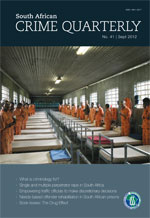 Why are criminal acts in South Africa so violent?
This is the question that Bill Dixon poses to criminologists in South
Africa in this edition. He also offers some
insight into why it might be that South African academics and
independent researchers have, on the whole, not focused on finding
answers to this question – because instead they have tended to focus on
how crime can be controlled by police. The
article by Jewkes et al, states that no amount of fixing the police and criminal
justice system (however necessary and important that may be) will change
the fact that most rapes are motivated by sexual entitlement and the
desire for ‘entertainment’. In a telling Freudian
slip when referring to ‘increasing trends in child abuse’ he said “we
will declare war on children”. And as the police increasingly become the
frontline response of the ANC and government to violent public protests
against a range of municipal inefficiencies, corruption and political
party infighting; and as the casualties mount; we will no doubt find
ourselves trapped in a rhetoric of war. Why are criminal acts in South Africa so violent?
This is the question that Bill Dixon poses to criminologists in South
Africa in this edition. He also offers some
insight into why it might be that South African academics and
independent researchers have, on the whole, not focused on finding
answers to this question – because instead they have tended to focus on
how crime can be controlled by police. The
article by Jewkes et al, states that no amount of fixing the police and criminal
justice system (however necessary and important that may be) will change
the fact that most rapes are motivated by sexual entitlement and the
desire for ‘entertainment’. In a telling Freudian
slip when referring to ‘increasing trends in child abuse’ he said “we
will declare war on children”. And as the police increasingly become the
frontline response of the ANC and government to violent public protests
against a range of municipal inefficiencies, corruption and political
party infighting; and as the casualties mount; we will no doubt find
ourselves trapped in a rhetoric of war.
Read more...
Peace and Security Council Report No 39
This month our researchers in Addis Ababa and Dakar have
produced country analyses on Somalia, South Sudan and Côte d’Ivoire, focusing
on the introduction of Somalia’s new constitution, the inauguration of a new
Federal Parliament and the election of President Hassan Sheikh Mohamud, as well
as many remaining challenges; the status of the relationship between South
Sudan and Sudan and the former’s ongoing challenges as well as some successes; and
DDR, SSR and reconciliation issues in Côte d’Ivoire.
Read more...
Situation Report: Kenya`s Neglected IDPs, Internal
Displacement and Vulnerability of Pastoralist Communities in Northern
Kenya
Internal displacement has forced hundreds of thousands of pastoralists
from their homes and lands in northern Kenya. There are estimated to be
200 000 to 400 000 displaced people in the region. Although the dire
humanitarian consequences of this have persisted for decades,
understanding and awareness of the issue, and responses to it, are
woefully inadequate. The voices of internally displaced pastoralists
often go unheeded in both national and international discourses in
response to the crisis. This report investigates the situation
surrounding these displaced pastoralists. It examines the causes of
their displacement, the legal basis for their protection and the
shortcomings in responding to the problem. To address these, the report
gives recommendations for the government of Kenya, traditional leaders
and donors.
Read more...
Policy Brief 37:
Leadership Required: Drug Trafficking and the Crisis of Statehood in West Africa
Beginning
in the middle of the last decade, the international community was alerted to
the fact that drug trafficking in West Africa was in danger of spawning a
series of near ‘narco-states’: countries whose economies, politics and social
structures were being infiltrated and distorted by the drug trade. This policy brief
aims to remind any actor or institution that is serious about democracy,
sustainable development and human security that a ‘business as usual’ approach
to the problem of trafficking in West Africa should not be accepted. This is no
longer an issue of crime, law enforcement, or security, but strikes at the core
of the human rights, democratic and humanitarian foundations upon which global
governance rests.
Read more...
|