The SARPCCO Female Police Gender Advisors/Mentors Course Task Team Meeting
The Task Team meeting was to design and develop the SARPCCO Female Police Officers Gender Advisors/Mentors Course outline.
Date: 2012-09-25 to 2012-09-27
Compiled by Festus Aboagye, Senior Research Fellow, ISS/TfP
Introduction
The idea of establishing a SARPPCO Female Police Gender Advisors/Mentors Course forms part of long-standing TfP objectives at building and enhancing regional capacity for participation in UN and/or AU peace operations. In particular, the idea seeks to also contribute to the achievement of the objectives of UN Security Council Resolution 1325 (2000) on Women, Peace and Security (WPS). The key objective areas of this focus are increased participation of women in peace implementation, as well as the protection, prevention and empowerment of vulnerable populations, notably women and men, and boys and girls.
Background
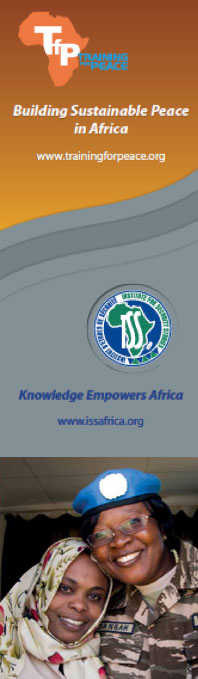 In United Nations (UN) peacekeeping missions, peacekeepers are directed to defend human rights in all their work. The commitment of the UN Security Council in this regard is reaffirmed by the full and effective implementation of resolutions 1325 (2000) and 1820 (2008), in incorporating a gender perspective into peacekeeping operations, including a gender component amongst the core functions of their work.
UN peacekeeping mandates also urge member states, as well as international, regional and sub-regional organisations, to take measures to increase the participation of women in conflict prevention, conflict resolution and peacebuilding, and to strengthen the role of women as decision-makers in these areas.
The Security Council has recognised the inter relationship between gender perspectives and other thematic issues such as the protection of civilians in armed conflict (S/PRST/2008/18, children and armed conflict(S/PRST/2008/6), the maintenance of international peace and security (S/PRST/2007/31), and security sector reform (S/PRST/2007/3).
At the regional level, the 17thAnnual General Meeting of the Southern African Police Chiefs organisation (SARPCCO) in 2012, through its resolution 7, acknowledged the need for training and capacity building programmes with regard to gender and mentoring issues. The Police Chiefs Committee took note of the joint consultation and resultant consensus of the Training and Women Network Sub Committees on the need for a gender and mentoring advisory course. The Committee approved of theidea and mandated the establishment of a Training and Women Network SubCommittees Joint Team to develop the course, with support from the Institute for Security Studies (ISS), through its training for Peace (TfP) project.
Purpose of the Meeting
In accordance with the foregoing background, the purpose of the Task Team meeting was to design and develop the SARPCCO Female Police Officers Gender Advisors/Mentors Course outline.
Venue, Date and Participation
The meeting was held at the Arcadia hotel, Pretoria, from 25-27 September 2012.
Ten (10) participants attended the meeting. They were drawn from the INTERPOL Regional Bureau in Harare, and delegates from Malawi (1), Tanzania (1), South Africa (4) and Zimbabwe (1). The ISS/TfP, in conjunction with a consultant, provided technical support and facilitation for the substantive discussions. In gender terms, the meeting comprised seven (7) females and three (3) males. The list of participants is attached.
Agenda for the Meeting
The meeting was opened by Lt Col Nkosinathi Nomvalo, who is incharge of the SARPCCO Desk at the National Central Bureau of the INTERPOL in Pretoria. After warmly welcoming the participants to the meeting, Lt Col Nomvalo started his remarks by underscoring the importance of increasing the participation of women police in peacekeeping, among others, as part of society and to perform functions that complement their male counterparts. He placed this in the context of UN Security Council resolution 1325 (2000).
As part of the agenda, time was set aside for the members to introduce themselves and get to know, as well as appreciate, the background of each participant, especially their peacekeeping and gender subject matter knowledge, skills and experience.
The meeting started with a DVD and general discussion of a WPS documentary, Side by Side (this was presented at the 18th IAPTC Conference in Helsinki, Finland in September 2012). The main discussions of the meeting revolved around the following sets of key agenda items, namely:
- The background concept paper, including justification and rationale for the establishment of the course period
- Introduction of the key documents for the meeting, notably the relevant UNSC resolutions, the UN DPKO Police Standardised Best Practices Toolkit on Gender and International Police Peacekeeping
- Defining the training objectives, identifying critical course modules and their aims, and the core subjects / lessons of each module.
Some of the agenda items, though outlined in the outline concept / brochure could not be treated for lack of time.
Draft Course Outline
Course Objectives
Further to the outline concept / brochure, the meeting agreed on the following draft training objectives for the proposed course, as being:
To equip participants with the necessary tools to enhance gender mainstreaming by:
- Translating UN/AU peacekeeping mandates on gender equality into practice, and supporting capacity building of the police
- Assisting in mentoring, advising and training national police, including community policing and gender, investigating sexual and gender-based violence
- Promoting and ensuring that communities have access to police services in missions
- Raising awareness on gender issues so that the police are able to create linkages with organisations and community groups representing women
Outline of Modules
Inline with the broad objectives stated earlier, the meeting identified the following modules as being critical to the attainment of the training objectives:
- a) Introduction to Women, Peace & Security:
a) Relevance of Gender.
b) Terms and Definitions.
c) Impact of Conflict on Men and Women (and Children).
d) Empowerment:
i) National Action Plans (Police Focus).
ii) Motivational Seminar / Talk (with former female leader(s) for participants to be ready to take decision-making posts within missions).
- Legal Framework: UN Security Council Resolutions / AU Resolutions & Other International Guidelines.
- UN Global Effort Initiative.
- Protection of Civilians: An Overview of Police Role, Functions and Tasks.
- Development & Implementation of Gender-Related Policies / DPKO Guidelines on Integrating Gender Perspectives into Work of Police Missions.
- Capacity Building: SGBV Prevention and Investigation, & Coordination with Victim Support.
- Mentoring, Monitoring and Advising, Diversity, Negotiation and Mediation, Effective Communication, & Community Policing.
- SAAT: Female Driving Support.
- Practical Field Exercise.
The meeting also drafted the aims of each module, their learning outcomes and the core lessons / subjects to be included under the respective modules.
In accordance with the training policy of SARPCCO, the meeting agreed to include a preliminary module on the INTERPOL, SADC, SARPCCO and the SARPCCO Women’s Network Committee. In addition, the meeting considered the need for additional modules on the UN’s Selection Assessment and Assistance Training (SAAT),including sourcing for female driving support; as well as a brief Capstone Practical Field Exercise. These additional modules are to be further out lined by the facilitation group (INTERPOL, the Consultant and the ISS / TfP) for review during the next meeting.
Next Steps
A second meeting is planned for the Task Team in December 2012, to review the outputs from the first meeting, and finalise the course package, in prelude to its third meeting in the first quarter of 2013.
Among others, the second meeting will seek to streamline the following items:
- Training audience (gender composition, rank bracket, future / pre-mission or mission employment / post, gender competency & experience).
- Methodologies: case studies, group discussions, audio-visuals, lectures, presentations, practical exercise.
- Draft outline course programme.
- Minimum M & E requirements in design and conduct of the course.
- Identifying course reading materials.
- Outline of course reader and trainers manuals.
- Course validation and the way forward.
- Identifying training facilitators.
Conclusion
The first meeting of the SARPCCO Task Team for the design and conduct of the SARPCCO Female Police Officers Gender Mentors/Advisors course achieved its first objective of developing a course outline, although some work remains to be done on a few of the identified modules. The Team remains hopeful that it would be able to finalise the course outline during its second meeting, to set the stage for a more thorough review of the course package during the early part of 2013.
On behalf of SARPCCO and the ISS, the Team extends its appreciation and thanks to the South African Police Service for the excellent hosting facilities, and to the Royal Norwegian Government, through its Ministry for Foreign Affairs, for funding support.
Want to Share Best Practices?
Persons and institutions that want to share best practices in this endeavour may contact:
Festus B. Aboagye
Senior Research Fellow
Institute for Security Studies
Tel: +27 12 346 9500
Email: [email protected]
PO Box 1787, Brooklyn Square, Pretoria, 0075, South Africa
Websites: www.trainingforpeace.org; and www.issafrica.org.
