| 12 February 2015 |
| |
 |
TALKING POINT
The AU starts to put its money (closer to) where its mouth is
by Peter Fabricius |
|
As the AU moves towards greater financial independence, it's unclear whether all member states can, or even want to, pay their dues.
The African Union has been loudly proclaiming its independence since its birth, as the Organisation of African Unity, in 1963. Yet, even as it was shaking its one collective fist at meddling neo-imperialists and the like, the AU was taking their money with the other.
Read more...
|
|
| |
| Press release |
| |
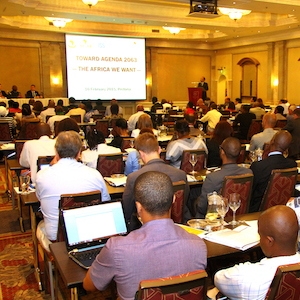 |
| Toward Agenda 2063: what progress has been made? |
What are the key policy and development decisions that could bring the continent in line with the AU's Agenda 2063, and closer to the Africa we want?
Read more... |
|
| |
| ISS Today |
| |
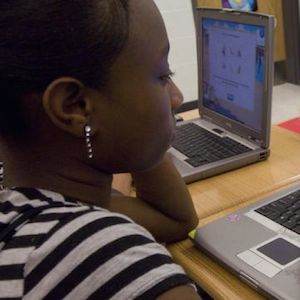 |
Cyberspace: new frontiers for gender violence
by Khalil Goga |
As technology develops, new forms of gender-based victimisation arise. However, governing the Internet to protect individuals remains a balancing act.
Read more... |
|
| |
 |
The fight against Boko Haram tangled up in Nigerian and regional politics
by Lori-Anne Théroux-Bénoni |
Without buy-in from Nigeria on the military response and beyond, no lasting solution to the Boko Haram problem is possible.
Read more... / Pour la version française, cliquez ici... |
|
| |
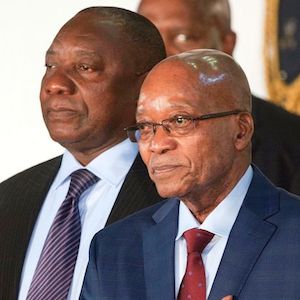 |
President Zuma and a nation in a state of distress
by Judith February |
South African President Jacob Zuma will deliver his state of the nation address on Thursday against a backdrop of increasing inequality.
Read more... |
|
| |
 |
Africa's maritime security wish list for 2015
by Timothy Walker |
When reflecting on maritime security in 2014, there is a good story to tell - but it is not the only one.
Read more... |
|
| |
| Events |
| |
 |
Xenophobia in South Africa: myths and realities
13 February 2015 |
Are the latest attacks on foreign-owned shops opportunistic crimes or symptomatic of a xenophobic society?
Register here... |
|
| |
 |
What are reasonable goals for reducing poverty in Africa?
18 February 2015 |
Setting aggressive yet realistic targets is essential for reducing poverty and achieving Agenda 2063.
Register here... |
|
| |
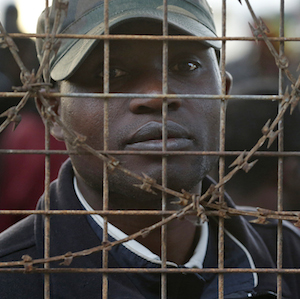 |
Xenophobia in Africa
Course application deadline: 20 February 2015 |
The course will examine xenophobia, and interrogate discrimination based on national identity in various parts of Africa.
Course details... |
|
| |
 |
| What stops rape survivors from reporting? |
Sexual offences are severely underreported in South Africa. To address this, radical change is needed in how statistics are currently used.
Read more... |
|
| |
| Publications |
| |
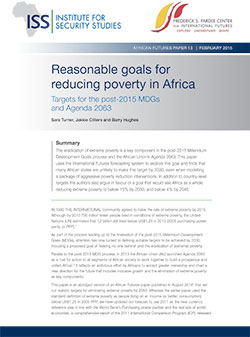 |
Reasonable goals for reducing poverty in Africa: targets for the post-MDGs and Agenda 2063
by Sara Turner, Jakkie Cilliers and Barry Hughes |
African states are unlikely to reach the targets of the AU's Agenda 2063, but should aim to reduce extreme poverty to below 4% by 2045.
Read more... |
|
| |
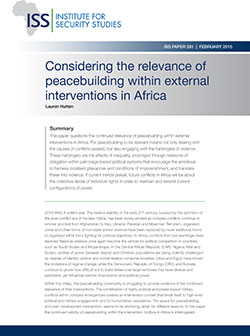 |
Considering the relevance of peacebuilding within external interventions in Africa
by Lauren Hutton |
Until the politically and economically weak are protected in the same manner as the powerful and wealthy, we may as well signal the end of peacebuilding.
Read more... |
|
| |
| Multimedia |
| |
 |
| Can the new joint task force defeat Boko Haram? |
Martin Ewi explains how the Boko Haram crisis has been allowed to escalate, and says the new joint task force will most likely be inadequate.
Watch online... |
|
| |
 |
| Setting realistic poverty reduction goals |
The AU’s Agenda 2063 and the UN post-2015 Millennium Development Goals are in progress, how can both organisations set realistic targets to eliminate extreme poverty?
Watch online... |
|
| |
| Connect with the ISS |
|
|
| |
| The Institute for Security Studies is grateful for the support of the following core partners: the governments of Australia, Canada, Denmark, Finland, Japan, the Netherlands, Norway, Sweden and the United States. |
|
| |
